Marine Ground Intelligence Officer
Ground intelligence is one of four entry-level tracks in the Marine intelligence officer field. The 0203 Ground Intelligence Officer leads ground surveillance and reconnaissance collection and supports a unit’s intelligence effort. The officer remains an intelligence officer when serving alongside infantry or reconnaissance forces.
A 0203 attends the Infantry Officer Course and supports ground surveillance and reconnaissance. Completing that course does not award the infantry primary MOS, 0302, or guarantee a reconnaissance billet. The distinction is between shared training and the qualification actually awarded.
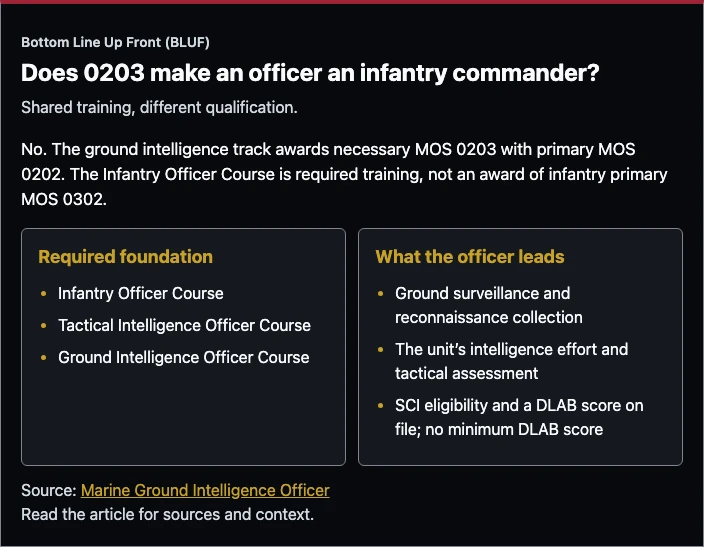
No. The ground intelligence track awards necessary MOS 0203 with primary MOS 0202. The Infantry Officer Course is required training, not an award of infantry primary MOS 0302.
Required foundation
- Infantry Officer Course
- Tactical Intelligence Officer Course
- Ground Intelligence Officer Course
What the officer leads
- Ground surveillance and reconnaissance collection
- The unit’s intelligence effort and tactical assessment
- SCI eligibility and a DLAB score on file; no minimum DLAB score
Source: Marine Ground Intelligence Officer
Read the article for sources and context.
On this page
Job Role and Responsibilities
The FY27 intelligence MOS entries distinguish the 0202 primary specialty from the necessary MOS qualifications described below. The manual took effect on October 1, 2026.
Marine ground intelligence officers lead ground surveillance and reconnaissance collection, coordinate the intelligence effort of the unit they support, and advise commanders on what the ground picture actually shows. They plan and direct the collection that infantry and reconnaissance operations depend on, and they do it as intelligence officers rather than as maneuver commanders.
The 0203 is not a separate career from the intelligence field. It is a necessary MOS associated with the 0202 Intelligence Officer primary MOS, and an officer who completes the required courses is assigned both. The parent profile for that architecture is the Marine intelligence officer overview, which explains how the primary MOS and the specialty tracks fit together.
| MOS Code | Title | What it is | Required courses the manual lists |
|---|---|---|---|
| 0202 | Intelligence Officer | Primary MOS for the field | Tactical Intelligence Officer Course, plus a specialty course |
| 0203 | Ground Intelligence Officer | Necessary MOS associated with 0202 | Infantry Officer Course, TIOC, Ground Intelligence Officer Course |
| 0302 | Infantry Officer | Separate primary MOS | Infantry Officer Course |
Company grade 0203s work where collection meets maneuver. The officer leads a ground collection element, sets surveillance and reconnaissance priorities against the supported commander’s requirements, and turns what the element reports into something a commander can act on. The manual describes this as leadership of ground units in tactical information gathering, alongside responsibility for the manning, training and equipping of those Marines.
As a staff officer, a 0203 analyzes information, estimates the tactical situation, and helps coordinate the unit’s intelligence effort. Command and collection-leadership responsibilities remain part of the specialty’s published description. The assigned billet determines which responsibilities the officer exercises.
The specialty also includes analysis, rather than collection supervision alone. Ground collection produces fragments, and someone has to decide which fragments change the commander’s understanding. An officer who treats the billet as supervision rather than interpretation will find the reporting pile up without informing anyone.
The award requirements name the Infantry Officer Course, Tactical Intelligence Officer Course, and Ground Intelligence Officer Course. They do not award a scout sniper, airborne, or diving qualification. A specific reconnaissance assignment also requires an actual billet, not an assumption based on the course names.
Salary and Benefits
Ground intelligence officers are paid on the same officer basic pay table as every other Marine officer. The 2026 monthly basic pay rates for junior officer ranks are shown below.
| Rank | Pay Grade | YOS <2 | YOS 2 | YOS 4 | YOS 6 |
|---|---|---|---|---|---|
| Second Lieutenant (2ndLt) | O-1 | $4,150 | $4,320 | $5,222 | $5,222 |
| First Lieutenant (1stLt) | O-2 | $4,782 | $5,446 | $6,484 | $6,618 |
| Captain (Capt) | O-3 | $5,534 | $6,274 | $7,383 | $7,737 |
| Major (Maj) | O-4 | $6,295 | $7,286 | $7,881 | $8,332 |
Source: DFAS 2026 pay tables. Figures reflect the 2026 pay raise.
Eligible officers may receive Basic Allowance for Subsistence and Basic Allowance for Housing. Housing entitlement and rates depend on the applicable duty location, grade, dependency status, and other conditions. The intelligence officer overview sets out the shared officer benefit package in full.
The basic-pay table is the same across intelligence tracks at the same grade and service bracket. Bonuses and special or incentive pays depend on their own current eligibility rules, so the specialty code alone does not establish the officer’s complete compensation.
Qualifications and Eligibility
Every 0203 begins as a Marine officer candidate. Commissioning runs through the standard routes and the intelligence officer overview describes each one. What matters here is the screening that applies once an officer is assigned to the ground track.
| Prerequisite | Detail |
|---|---|
| Security eligibility | Sensitive compartmented information eligibility based on a single scope background investigation, SSBI or T5 |
| Language aptitude | A Defense Language Aptitude Battery score on file in the official military personnel file. No minimum score is required |
| Counterintelligence polygraph | Not listed as a specialty prerequisite for this track |
The manual does not list a polygraph for the 0203, unlike the counterintelligence and human intelligence track, which requires willingness to submit to a counterintelligence scope examination. That absence is a fact about the specialty’s prerequisites, not an exemption from the security standards that apply to every intelligence officer.
The DLAB requirement concerns a recorded score. The requirement is a score on file, not a qualifying score. A Marine who scores above 100 may be designated for formal language training, which is an opportunity rather than an entry gate, and an officer who scores below it is not excluded from the specialty.
The intelligence specialty tracks are allocated against the Marine Corps’ production requirements rather than selected as guaranteed individual assignments. Completing the required courses awards the 0202 primary MOS and the 0203 necessary MOS. Assignment to a training track and award of its qualification are separate steps.
Work Environment
Ground surveillance and reconnaissance place the officer in work that connects collection with a supported unit’s needs. Planning, training, and readiness support the collection effort before operations; reporting and assessment help the commander use the resulting information. The unit and assignment determine the setting and schedule.
The chain of command runs through the supported commander and the intelligence officer above the element. A 0203 leads Marines directly at company level and answers upward for what the element collects and how it reports. At staff level the officer works inside a G-2 or S-2 section and coordinates collection across a larger formation.
A useful assessment explains what the collection shows, how confident the judgment is, and what information remains missing. The manual’s staff duties include evaluating information and estimating the tactical situation. That gives analysis a purpose beyond producing more reports.
Staff and command time alternate as they do across the officer corps. Company grade billets are operational and supervisory. Field grade billets are coordinating and advisory, with more time in planning forums and less with the collection element itself.
Training and Skill Development
The course list is where this specialty differs most from its siblings. Ground intelligence is the only intelligence track that requires the Infantry Officer Course, which comes in addition to the intelligence courses every specialty requires.
| Phase | Location | Focus |
|---|---|---|
| The Basic School | MCB Quantico, VA | Six months of officer foundation for every Marine officer |
| Infantry Officer Course | The Basic School, Quantico, VA | Infantry tactics and small-unit leadership, the same course infantry officers attend |
| Tactical Intelligence Officer Course | Marine Corps Detachment Dam Neck, VA | The common intelligence foundation shared by all four entry tracks |
| Ground Intelligence Officer Course | Marine Corps Intelligence Schools, Dam Neck, VA | Ground collection planning and the ground intelligence specialty |
The Infantry Officer Course is a distinctive requirement of the ground track. Sharing that course with infantry officers does not award the 0302 primary MOS. The intelligence course sequence and the resulting codes identify the separate qualification.
The Tactical Intelligence Officer Course comes first among the intelligence courses. It provides the common foundation every intelligence officer receives before specializing, and the specialty course follows it.
The 0203 entry names the Ground Intelligence Officer Course, and the 0209 prerequisite entry groups the entry-level intelligence courses at Marine Corps Intelligence Schools, Dam Neck. Neither establishes a current course calendar. Ask the training authority about the scheduled dates rather than treating the course title as a timetable.
Professional military education follows the standard officer track. Expeditionary Warfare School at the captain level and Command and Staff College at the major level apply as they do to every officer, and the intelligence community adds joint intelligence training for officers who stay in the field.
Career Progression and Advancement
The 0203 is held from second lieutenant through lieutenant colonel. Promotion follows the applicable officer promotion system. The MOS grade band is not a promotion schedule.
| Career stage | What to distinguish |
|---|---|
| Company-grade officer | Tactical unit leadership or an assigned intelligence staff billet |
| Field-grade officer | Broader command or staff responsibilities, depending on the actual assignment |
| Change in military grade | Promotion under the officer personnel system, separate from an added course qualification |
The table illustrates the difference between tactical leadership and larger staff responsibilities; it is not a guaranteed sequence of assignments. Promotion and billet selection depend on the applicable personnel processes. The MOS manual does not rank these billets for selection boards.
The specialty does not create a separate promotion track. A 0203 competes for promotion alongside every other intelligence officer, and the ground specialty is recorded as a necessary MOS rather than replacing the primary MOS. Officers who later move into joint or national-level intelligence billets carry the ground background as context rather than as a credential that substitutes for the broader field.
Physical Demands and Medical Evaluations
The Marine PFT and CFT score classifications identify first class as 235 to 300 points. A classification threshold is different from a specialty entry requirement or a medical clearance.
Successful completion of the Infantry Officer Course is an award requirement for the ground intelligence track. It is additional training beyond the intelligence courses. The shared course does not change the primary MOS awarded through the intelligence pipeline.
Beyond that course, the 0203 meets the same annual standard as every other Marine officer: a PFT and a CFT each year, each scored out of 300 points, with 235 as the start of the first-class score band. The intelligence officer overview carries the current event list and the plank standard.
The combat-arms PFT policy is tied to the primary MOSs named in the applicable guidance. Attending the Infantry Officer Course does not itself turn the 0203 necessary MOS into an infantry primary MOS. Course completion requirements must still be met alongside the fitness and medical rules applicable to the officer.
Security eligibility is a separate requirement from medical qualification. Sensitive compartmented information access depends on a current investigation and on continuous adherence to security and conduct standards.
Deployment and Duty Stations
Ground intelligence officers deploy with the units they support. That means the deployment pattern follows the supported command rather than a fixed intelligence unit rotation, and the officer’s location in theater follows the collection element.
The operational tempo builds during workup, when collection requirements are set against the commander’s priorities and the element trains to meet them. During deployment the officer is reporting continuously, and the reporting does not stop because the element is tired or the picture is incomplete.
The MOS entry describes the work without providing a station list. The actual billet and supported unit determine the assignment. A serving intelligence officer or personnel contact can identify the current organization and location relevant to an available opening.
Risk, Safety, and Legal Considerations
The risk in this specialty sits in two places. The first is the field, where a ground collection element operates forward with the supported unit and shares its exposure. That risk is real and it is not different in kind from the risk the supported unit carries.
The second is the risk of being wrong. Ground collection produces information that commanders act on, and an officer who reports a conclusion more confidently than the collection supports can move a unit toward a threat that is not there or away from one that is. The professional standard is to state what was observed, what was assessed and what remains unknown, and to resist the pressure to make a fragment sound like a picture.
Legal responsibility follows the same pattern as the rest of the field. The officer handles classified material within security rules, ensures the element collects within its authority, and answers to the chain of command for what the element reports and how it reports it. Command responsibility grows with grade, and relief for cause remains a real outcome when judgment fails badly.
Impact on Family and Personal Life
The family pattern tracks the supported unit rather than a fixed intelligence schedule. Deployments, field exercises and workups arrive on the supported command’s calendar, which means the officer’s family plans around a rhythm the officer does not set.
The timing of permanent change of station (PCS) moves depends on orders and career requirements. The geography follows the intelligence organizations that support the operating forces, so a ground intelligence officer should expect to move among the major installations rather than settle in one place.
Family support runs through Marine and Family Services at each installation, including deployment readiness briefings, family readiness groups and counseling. Ask the unit which support resources are available during field training and deployments.
Marine Corps Reserve
The FY27 manual applies to the Total Force, so the 0203 specialty is not an active-component-only qualification. What that establishes is applicability, not availability. Whether a specific reserve unit has an open ground intelligence billet, and whether the training pipeline can be scheduled around a civilian career, are separate questions that the manual does not answer.
A common drill pattern is one weekend per month plus an annual training period; initial training, exercises, and mobilization can require more time. The table below sets out how the reserve terms differ from active duty, and the intelligence officer overview explains the drill pay basis, TRICARE Reserve Select and the points-based retirement system.
| Factor | Active duty | Reserve |
|---|---|---|
| Routine commitment | Full-time service | Part-time drills and training, with possible full-time orders |
| Pay basis | Monthly basic pay by grade and service | Pay for the applicable duty or training periods |
| Health coverage | Active-duty coverage under applicable TRICARE rules | Eligible members may purchase TRICARE Reserve Select |
| Post-9/11 GI Bill | Benefit tier depends on qualifying service and other eligibility rules | Benefit tier depends on qualifying service and other eligibility rules |
| Retirement | Applicable active-duty retirement system | Qualifying years and points; retired-pay age can be reduced for qualifying service |
| Deployment | Based on the unit and assignment | Mobilization and deployment can interrupt civilian work |
TRICARE Reserve Select is a premium-based plan with eligibility conditions, not automatic coverage for every reservist. Reserve retired pay normally begins at age 60, with reduced-age eligibility for certain qualifying service. Those conditions should be checked alongside the training commitment before comparing components.
An Officer Selection Officer or a Reserve unit contact can establish current openings and the qualification attached to a billet. A Total Force listing does not establish how many seats are available or whether the training fits a particular civilian schedule.
Post-Service Opportunities
Ground intelligence experience can include collection leadership and analytical work under time pressure. Past clearance eligibility is not a guarantee of current access or eligibility after separation. The transferable skill is the ability to turn incomplete information into a defensible assessment and to say clearly how much confidence it deserves.
One civilian comparison is management analysis, which involves evaluating an organization’s work and recommending improvements. The Bureau of Labor Statistics management-analyst profile reports:
- National median annual wage: $101,860 in May 2025.
- Projected employment growth: 10% from 2025 to 2035.
These are occupation-wide figures for SOC 13-1111, not starting salaries or measured outcomes for former intelligence officers.
A civilian application needs to show the actual work behind the military title. Describe unclassified experience in analysis, planning, supervising a team, and explaining a recommendation, with examples appropriate to the vacancy. Do not assume a military code establishes a civilian credential, a current clearance, or an employer’s hiring decision.
Possible areas to investigate include federal intelligence and defense analysis, corporate security, and defense contracting. Compare each vacancy’s actual duties and credentials with the officer’s documented experience. Neither the specialty code nor past access to classified information guarantees that a civilian employer can use that experience in the same way.
For further education, benefit eligibility matters as well as school choice. The Post-9/11 GI Bill rates provide net tuition and mandatory fees at public institutions and up to $30,908.34 at private institutions at the 100% benefit tier for August 1, 2026, through July 31, 2027. Lower eligibility tiers receive a percentage of the full rate.
Is This a Good Job for You? The Right (and Wrong) Fit
This specialty fits officers who want to be close to the fight without commanding it. The work puts you beside infantry and reconnaissance units, in the same environment, doing a different job. If that combination appeals, the specialty is a strong match.
It also fits officers who are comfortable being the person who says the picture is incomplete. Ground collection rarely produces certainty, and the officer who cannot deliver a qualified answer will either overstate or stay silent. Both fail the commander.
It does not fit someone who wants to command infantry. The shared Infantry Officer Course is real training, and it is not a route into the infantry primary MOS. An officer whose actual goal is a rifle company should pursue that directly rather than hoping the intelligence specialty leads there.
It also does not fit someone who wants a guaranteed reconnaissance assignment. The specialty supports reconnaissance and works alongside it. It does not promise it.
If you want the broader intelligence picture before choosing, the intelligence officer overview covers the primary MOS and the other three specialty tracks, and the infantry officer profile covers the command career this specialty is most often confused with.
More Information
Speak with an Officer Selection Officer about current 0203 allocation and about what the Infantry Officer Course requires before you commit to the track. Ask the training authority about current Ground Intelligence Officer Course dates and attendance requirements.
The other intelligence specialty tracks are covered on their own pages: counterintelligence and human intelligence, signals intelligence and electromagnetic warfare, air intelligence and MAGTF intelligence planning.
Our test-prep guides cover the enlisted ASVAB and the aviation ASTB-E. Neither applies to the intelligence officer pipeline, which screens through the DLAB and security eligibility instead.