Marine MAGTF Intelligence Planner
The 0209 MAGTF intelligence planner qualification requires selection or promotion to major. It is a later-career qualification built on intelligence training and professional military education, not an entry-level specialty awarded to a new second lieutenant.
That makes this page a different kind of article from the other intelligence specialty pages. It is not an accession guide. It answers one question: when does an intelligence officer become a MAGTF intelligence planner, and what changes when that happens.
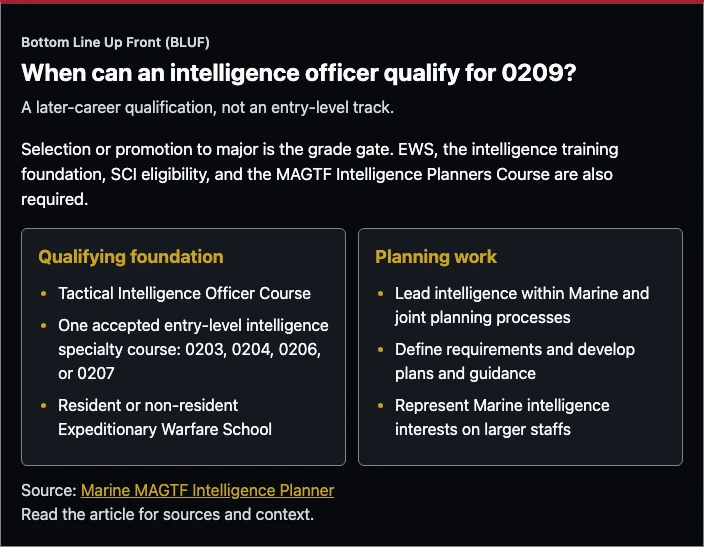
Selection or promotion to major is the grade gate. EWS, the intelligence training foundation, SCI eligibility, and the MAGTF Intelligence Planners Course are also required.
Qualifying foundation
- Tactical Intelligence Officer Course
- One accepted entry-level intelligence specialty course: 0203, 0204, 0206, or 0207
- Resident or non-resident Expeditionary Warfare School
Planning work
- Lead intelligence within Marine and joint planning processes
- Define requirements and develop plans and guidance
- Represent Marine intelligence interests on larger staffs
Source: Marine MAGTF Intelligence Planner
Read the article for sources and context.
On this page
Job Role and Responsibilities
The FY27 intelligence MOS entries distinguish the 0202 primary specialty from the necessary MOS qualifications described below. The manual took effect on October 1, 2026.
A MAGTF intelligence planner is a field grade Marine intelligence officer who plans intelligence operations at the operational level and leads the intelligence effort inside the Marine Corps Planning Process and the Joint Planning Process. The 0209 represents the Marine Corps Intelligence, Surveillance and Reconnaissance Enterprise on MAGTF, joint, coalition and interagency staffs.
The specialty sits at the senior end of the intelligence field. Where a company grade officer runs an intelligence section, an 0209 shapes how intelligence supports a campaign plan, defines the requirements a collection enterprise has to satisfy, and negotiates the intelligence contribution across organizations that do not report to the same commander.
| MOS Code | Title | Type | Grade Band |
|---|---|---|---|
| 0202 | Intelligence Officer | PMOS | 2ndLt to LtCol |
| 0209 | MAGTF Intelligence Planner | NMOS | Maj to LtCol |
| 0203 | Ground Intelligence Officer | NMOS, entry-level | 2ndLt to LtCol |
| 0204 | CI/HUMINT Officer | NMOS, entry-level | 2ndLt to LtCol |
| 0206 | SIGINT/Ground EW Officer | NMOS, entry-level | 2ndLt to LtCol |
| 0207 | Air Intelligence Officer | NMOS, entry-level | 2ndLt to LtCol |
The grade band is the clearest signal of what this specialty is. Every other intelligence specialty listed above spans second lieutenant to lieutenant colonel because those are entry tracks that an officer can hold for an entire career. The 0209 begins at major.
The planner’s responsibilities depend on the setting:
- Operating forces: The planner serves on MAGTF and major subordinate command staffs. The officer needs to know the intelligence structure, processes, and capabilities of both the MAGTF and the Marine Corps Intelligence, Surveillance and Reconnaissance Enterprise well enough to task them.
- Supporting establishment: The planner represents that enterprise in how intelligence capabilities are generated and employed, and integrates them with joint, interagency, intergovernmental, and multinational partners.
- Joint and coalition billets: The planner represents Marine Corps intelligence interests and equities.
The work product is plans, guidance and policy rather than finished intelligence. An 0209 defines requirements, develops plans, interprets external guidance and applies it to a command, and leads the intelligence portion of a planning effort that other officers execute.
Salary and Benefits
An officer holding the 0209 specialty is a major or lieutenant colonel, so the relevant pay is at the O-4 and O-5 grades rather than at the entry rates. The table shows 2026 monthly basic pay at those two grades.
| Rank | Pay Grade | YOS 10 | YOS 12 | YOS 14 | YOS 16 |
|---|---|---|---|---|---|
| Major (Maj) | O-4 | $9,420 | $9,888 | $10,214 | $10,402 |
| Lieutenant Colonel (LtCol) | O-5 | $9,928 | $10,272 | $10,715 | $11,391 |
Source: DFAS 2026 pay tables. Figures reflect the 2026 pay raise.
Officers may also receive Basic Allowance for Housing, which varies by duty location, pay grade and dependency status. Basic Allowance for Subsistence uses a single officer rate and does not increase with grade or dependency status. These allowances are separate from basic pay.
The benefit structure does not change when an officer reaches this specialty. The intelligence officer overview sets out TRICARE Prime, dental, leave, the Blended Retirement System and Tuition Assistance in full.
For retirement planning, use the retirement system and creditable service applicable to the individual officer. Holding the planner qualification does not change the basic-pay system or independently establish pension eligibility.
Qualifications and Eligibility
This section is the core of the page, because the 0209 is defined by its prerequisites. All five must be met, and they are cumulative.
| Prerequisite | Detail |
|---|---|
| Grade | Selection or promotion to major |
| Professional military education | Resident or non-resident Expeditionary Warfare School completed |
| Intelligence foundation | Tactical Intelligence Officer Course completed |
| Security eligibility | Sensitive compartmented information eligibility based on a single scope background investigation, SSBI or T5 |
| Specialty foundation | Completion of one entry-level intelligence course for NMOS 0203, 0204, 0206 or 0207 |
The specialty-course prerequisite accepts any one of the four listed entry-level intelligence tracks. Air intelligence and CI/HUMINT are therefore both qualifying foundations when the other prerequisites are met. The entry does not require every planner to come from the same track.
The requirement that follows is the course itself. Active duty and reserve officers complete the MAGTF Intelligence Planners Course at Marine Corps Detachment Dam Neck, Virginia.
Older guidance may use a different course name or omit a current prerequisite. For this qualification, use the FY27 entry’s major-selection, EWS, intelligence-training, and security conditions. Confirm the current course registration with the training authority rather than substituting an older course description.
The 0209 is not an accession specialty. Its prerequisites require the intelligence foundation, grade selection, education, and security eligibility described above. Timing matters only after those eligibility conditions are met.
Work Environment
The setting is a planning room. An 0209 spends the working day in a headquarters environment, moving between planning boards, working groups, briefings to senior officers and the coordination that connects a plan to the organizations expected to execute it.
The Marine Corps Planning Process and the Joint Planning Process structure that work. Both are deliberate, sequential and documented, and the intelligence planner owns the intelligence portion of each step: the problem framing, the intelligence estimate, the collection requirements that follow, and the assessment of whether the plan can be supported with the intelligence the enterprise can actually deliver.
The chain of command runs through the G-2 or J-2 of the supported command. The planner advises that officer and works alongside the operations, logistics and plans directorates, because a plan that intelligence cannot support is not a plan.
Planning requires coordination with other officers, warrant officers, and senior enlisted specialists. The planner integrates requirements and capabilities across the staff. The actual billet determines any direct supervisory responsibilities.
Staff time dominates and command time is limited at this grade. The 0209 is a staff specialty, and the officers who hold it are usually serving in billets where influence runs through the planning process rather than through a unit.
Training and Skill Development
The training path to this specialty is the accumulated intelligence pipeline plus the field grade courses that come with promotion.
| Phase | Timing | Focus |
|---|---|---|
| The Basic School | Before any specialty | Six months of officer foundation at Quantico |
| Tactical Intelligence Officer Course | As a new intelligence officer | The common intelligence foundation for all four entry tracks |
| One entry-level specialty course | As a new intelligence officer | 0203, 0204, 0206 or 0207, completed to earn the 0202 primary MOS |
| Expeditionary Warfare School | As a captain | Operational planning and joint doctrine, resident or non-resident |
| MAGTF Intelligence Planners Course | After selection to major | Operational and theater-level intelligence planning at Dam Neck |
The planners course is where the officer learns to work at the level the specialty requires. It covers the planning processes in depth, the intelligence architecture that supports a MAGTF and a joint force, and the coordination required to bring national and theater intelligence capabilities to bear on a Marine plan.
Professional military education continues alongside the officer’s career. Attendance at later schools depends on the applicable eligibility, selection, and assignment process. The 0209 qualification itself does not guarantee a place at Command and Staff College, the School of Advanced Warfighting, or a war college.
Career Progression and Advancement
The defining feature of this specialty is that it appears partway up the career ladder rather than at the bottom.
| Career stage | Qualification distinction |
|---|---|
| Entry-level intelligence | 0202 with the appropriate entry-level specialty qualification |
| Selected for or promoted to major | Meets the grade prerequisite, but the education and training conditions still apply |
| Required education and planners course completed | Eligible for award of 0209 when all conditions are met |
Promotion to major is the gate. An officer selected for major becomes eligible for the 0209, and completion of Expeditionary Warfare School and the planners course converts that eligibility into the specialty. Officers who are not selected for major do not reach it, which is why this specialty is best understood as a career milestone rather than a job assignment.
Planning billets give an officer responsibilities at the operational level, including coordinating intelligence requirements across organizations. The MOS entry does not rank those assignments against command billets for promotion. Career planning should use current personnel guidance alongside the qualification requirements.
Broadening assignments are common at this stage. Officers may serve as instructors at the intelligence schools, on joint staffs, in fellowships, or in the supporting establishment where they shape how intelligence capabilities are generated. They illustrate the range of work an intelligence officer may encounter; the MOS entry does not establish a promotion advantage for a particular assignment.
Physical Demands and Medical Evaluations
The Marine PFT and CFT score classifications identify first class as 235 to 300 points. A classification threshold is different from a specialty entry requirement or a medical clearance.
The 0209 entry does not list a separate specialty physical test. Officers still need to meet the Marine fitness, body-composition, and medical requirements applicable to them.
A PFT and a CFT are due each year, each scored out of 300 points, with 235 as the start of the first-class score band. The intelligence officer overview carries the current event list and the plank standard.
Scoring is age-normed, which matters more at this grade than for a new lieutenant. A major is measured against their own age bracket rather than the youngest group, and the requirement does not lapse as an officer moves into staff work.
Security eligibility is a separate requirement from medical qualification. Sensitive compartmented information access depends on a current investigation and on continuous adherence to security and conduct standards, and a planner who loses that access cannot do the job.
Deployed planners share the conditions of their assigned headquarters. The MOS entry does not establish that those conditions will be better than a tactical unit’s, or that hours will be predictable.
Deployment and Duty Stations
MAGTF intelligence planners deploy with the headquarters they support rather than with a tactical unit. That usually means a MEF, a Marine Expeditionary Brigade or a joint task force staff, and the deployment is tied to a command post rather than to a forward position.
The operational tempo at this level is driven by the planning cycle. A planner may spend months preparing a plan that is never executed, or may be pulled into a crisis response with days of notice. Both are normal.
The MOS description identifies MAGTF and major subordinate command staffs, the supporting establishment, and joint or coalition work. These are categories of assignment rather than a list of guaranteed stations. Current billets and orders determine the location.
Assignment is managed by the officer assignment monitors. At this grade the conversation is less about preference and more about the development track the monitor and the officer agree on.
Risk, Safety, and Legal Considerations
The risk profile for a planner is professional rather than physical. A planning error at this level propagates across a force, and an intelligence plan that cannot be supported by the collection enterprise it assumes will fail in execution.
The legal dimension is significant and grows with authority. Planners work with the authorities that govern intelligence collection, targeting and information sharing, and they interpret external guidance for a command. An officer who misapplies a policy constraint creates legal exposure that reaches well beyond the planning cell.
Safety protocols are administrative in a headquarters setting and physical in a deployed one. Deployed planners follow the force protection posture of the command they support.
Command responsibility at this grade is indirect but real. A planner who signs off on an intelligence estimate or a collection plan owns the judgment behind it, and relief for cause remains a possibility when that judgment fails badly.
Impact on Family and Personal Life
A planning billet does not guarantee a predictable schedule, fewer deployments, or an easier family routine. The headquarters and its mission determine the working pattern. Establish the expected absences and location from the actual assignment before making household plans.
Permanent change of station (PCS) timing depends on orders and career requirements. The geography is narrower than in a tactical field because the billets cluster at headquarters and schools, which can mean repeated moves among a small set of locations.
Dual-military couples at this grade face the same coordination problem as everyone else, with the added complication that both officers are likely in demanding staff roles at the same time.
Family support runs through Marine and Family Services at each installation, including deployment readiness briefings, family readiness groups and counseling.
Marine Corps Reserve
The 0209 is available to reserve officers. The manual states that active duty and reserve officers complete the same planners course, and the prerequisites apply to both components.
The Reserve qualification uses the same listed prerequisites and planners course. An officer must establish both eligibility and the training arrangement; scheduling is not the only condition. The course requirement does not guarantee an available seat.
A common drill pattern is one weekend per month plus an annual training period; initial training, exercises, and mobilization can require more time. The table below sets out how the reserve terms differ at this grade, and the intelligence officer overview explains the drill pay basis, TRICARE Reserve Select and the points-based retirement system.
| Factor | Active duty | Reserve |
|---|---|---|
| Routine commitment | Full-time service | Part-time drills and training, with possible full-time orders |
| Pay basis | Monthly basic pay by grade and service | Pay for the applicable duty or training periods |
| Health coverage | Active-duty coverage under applicable TRICARE rules | Eligible members may purchase TRICARE Reserve Select |
| Post-9/11 GI Bill | Benefit tier depends on qualifying service and other eligibility rules | Benefit tier depends on qualifying service and other eligibility rules |
| Retirement | Applicable active-duty retirement system | Qualifying years and points; retired-pay age can be reduced for qualifying service |
| Deployment | Based on the unit and assignment | Mobilization and deployment can interrupt civilian work |
TRICARE Reserve Select is a premium-based plan with eligibility conditions, not automatic coverage for every reservist. Reserve retired pay normally begins at age 60, with reduced-age eligibility for certain qualifying service. Those conditions should be checked alongside the training commitment before comparing components.
A Reserve planner may serve with a mobilized headquarters under the applicable orders. A civilian job and family plan should account for that possibility. The specialty does not establish a specific civilian occupation or level of seniority.
Post-Service Opportunities
Operational-level planning experience can include defining information requirements, developing plans, and coordinating across organizations. Those are responsibilities an officer can explain when comparing civilian vacancies. The MOS title alone does not establish how scarce that experience is in the civilian workforce.
One civilian comparison is management analysis, which involves evaluating an organization’s work and recommending improvements. The Bureau of Labor Statistics management-analyst profile reports:
- National median annual wage: $101,860 in May 2025.
- Projected employment growth: 10% from 2025 to 2035.
These are occupation-wide figures for SOC 13-1111, not starting salaries or measured outcomes for former intelligence officers.
A civilian application needs to show the actual work behind the military title. Describe unclassified experience in analysis, planning, supervising a team, and explaining a recommendation, with examples appropriate to the vacancy. Do not assume a military code establishes a civilian credential, a current clearance, or an employer’s hiring decision.
Possible areas to investigate include defense program work, intelligence analysis, risk planning, and consulting. Compare each vacancy with the officer’s documented experience and the credentials it requires. A planning qualification is not a promise of a senior civilian position.
Education funding depends on the program and the officer’s eligibility. The Post-9/11 GI Bill rates provide net tuition and mandatory fees at public institutions and up to $30,908.34 at private institutions at the 100% benefit tier for August 1, 2026, through July 31, 2027. Lower eligibility tiers receive a percentage of the full rate.
Is This a Good Job for You? The Right (and Wrong) Fit
This specialty is not something a candidate chooses at the start. It is something an intelligence officer grows into, and the question is whether the officer wants it when the opportunity arrives.
It fits officers who like the planning problem more than the production problem. The work is about defining requirements, sequencing effort, negotiating across organizations and writing the documents that make a plan executable. An officer who enjoyed running an intelligence section but finds planning boards tedious will not enjoy this.
It also fits officers who are comfortable with indirect influence. A planner rarely commands the people who execute the plan. The officer persuades, coordinates and builds consensus, and the results show up months later in someone else’s operation.
It does not fit an officer who wants to stay close to tactical intelligence work. Planners move away from the production floor, and officers who value that proximity should look at the 0204 CI/HUMINT officer or 0207 air intelligence officer tracks instead.
The intelligence officer overview covers the primary MOS and the entry-level tracks that lead here.
More Information
Speak with your assignment monitor and a senior intelligence officer about the timing of the 0209 in your career. The prerequisites are fixed, but the sequence of Expeditionary Warfare School, the planners course and a staff assignment is a career management decision rather than an application.
Our test-prep guides cover the enlisted ASVAB and the aviation ASTB-E. Neither applies at this stage. Officers reaching this specialty are screened on performance, professional military education and security eligibility instead.