Marine SIGINT and Ground Electromagnetic Warfare Officer
The 0206 officer leads signals intelligence and ground electromagnetic warfare units and advises commanders on their employment. The specialty combines leadership with knowledge of the capability. It is one of the four entry-level intelligence tracks associated with primary MOS 0202.
The 0206 officer specialty, cyberspace warfare, and the warrant route use some overlapping language but have different qualifications. Compare their duties, personnel category, and training before deciding which career to pursue. Technical subject matter alone does not make the routes interchangeable.
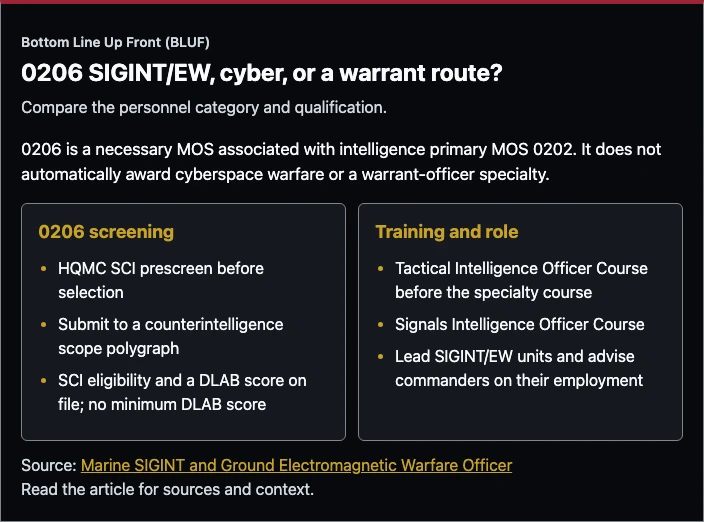
0206 is a necessary MOS associated with intelligence primary MOS 0202. It does not automatically award cyberspace warfare or a warrant-officer specialty.
0206 screening
- HQMC SCI prescreen before selection
- Submit to a counterintelligence scope polygraph
- SCI eligibility and a DLAB score on file; no minimum DLAB score
Training and role
- Tactical Intelligence Officer Course before the specialty course
- Signals Intelligence Officer Course
- Lead SIGINT/EW units and advise commanders on their employment
Source: Marine SIGINT and Ground Electromagnetic Warfare Officer
Read the article for sources and context.
On this page
Job Role and Responsibilities
The FY27 intelligence MOS entries distinguish the 0202 primary specialty from the necessary MOS qualifications described below. The manual took effect on October 1, 2026.
Marine SIGINT and ground electromagnetic warfare officers lead the units that collect signals intelligence and conduct ground electromagnetic warfare, and they advise commanders on how those capabilities should be employed. They direct collection against identified requirements and integrate the results into the command’s intelligence effort.
The 0206 is a necessary MOS associated with the 0202 Intelligence Officer primary MOS, and an officer who completes the required courses is assigned both. The Marine intelligence officer overview owns the architecture that connects the primary MOS to the specialty tracks.
The work divides along the same lines as the other intelligence specialties. Company grade officers lead collection elements and answer for what those elements produce. Field grade officers move into staff positions where they shape how SIGINT and electromagnetic warfare support a plan, and where they represent the capability to commanders who do not work in it daily.
| Role | Personnel category | What it is | Entry and training the manual lists |
|---|---|---|---|
| 0206 SIGINT and ground electromagnetic warfare | Intelligence NMOS on primary MOS 0202 | Leads SIGINT and EW units and advises on their employment | TIOC, then the Signals Intelligence Officer Course |
| 1702 Cyberspace Warfare | Separate primary MOS | Cyberspace operations officer | Its own accession and training path |
| 2602 SIGINT/Electromagnetic Warfare Operations | Warrant officer primary MOS | Technical specialist | Specified prior enlisted specialties, appointment eligibility, Warrant Officer Basic Course, own course |
The 0206 entry lists its related military skill as None. Cyberspace warfare is a separate career to compare, not a qualification the 0206 entry awards. A move between specialties requires the applicable eligibility and selection process.
The warrant route requires its own appointment and qualification process. Completing a commissioned-officer intelligence track does not automatically award a warrant-officer MOS. A candidate comparing the routes should start with the applicable personnel category and entry requirements.
The 0206 qualification is distinct from the cyberspace warfare primary specialty. The comparison is not a simple collection-versus-attack split. Different entry requirements and qualifications remain important even where the work touches related subjects.
Salary and Benefits
SIGINT and ground electromagnetic warfare officers use the standard officer basic-pay table. The 2026 monthly examples below are determined by grade and service, while special or incentive pays require their own eligibility checks.
| Rank | Pay Grade | YOS <2 | YOS 2 | YOS 4 | YOS 6 |
|---|---|---|---|---|---|
| Second Lieutenant (2ndLt) | O-1 | $4,150 | $4,320 | $5,222 | $5,222 |
| First Lieutenant (1stLt) | O-2 | $4,782 | $5,446 | $6,484 | $6,618 |
| Captain (Capt) | O-3 | $5,534 | $6,274 | $7,383 | $7,737 |
| Major (Maj) | O-4 | $6,295 | $7,286 | $7,881 | $8,332 |
Source: DFAS 2026 pay tables. Figures reflect the 2026 pay raise.
Eligible officers may receive Basic Allowance for Subsistence and Basic Allowance for Housing. Housing entitlement and rates depend on the applicable duty location, grade, dependency status, and other conditions. The intelligence officer overview sets out the shared officer benefit package in full.
Compare basic pay separately from any special or incentive pay. A language qualification or particular assignment may matter to an individual entitlement even though basic pay remains the same at the same grade and years of service. The MOS title alone does not settle those conditions.
Qualifications and Eligibility
Every 0206 begins as a Marine officer candidate, and the intelligence officer overview describes the commissioning routes. This track then applies the longest screening list of the four intelligence specialties.
| Prerequisite | Detail |
|---|---|
| Security prescreen | A sensitive compartmented information prescreen interview by the HQMC Special Security Office before selection |
| Counterintelligence polygraph | The officer must submit to a counterintelligence scope polygraph examination |
| Intelligence foundation | The Tactical Intelligence Officer Course completed |
| Security eligibility | Sensitive compartmented information eligibility based on a single scope background investigation, SSBI or T5 |
| Language aptitude | A Defense Language Aptitude Battery score on file. No minimum score is required |
The 0206 entry explicitly places the HQMC SCI prescreen before selection. Candidates should establish when that interview must be completed as part of their own training process. The entry’s ordering should not be replaced with an assumed later screening date.
The 0206 prerequisite requires submitting to a counterintelligence scope polygraph examination. That wording should be preserved rather than replaced with a claim about a different MOS’s standard. The training and security authorities establish the examination process applicable to an officer.
The entry’s header and award rule identify 0206 as a necessary MOS associated with primary MOS 0202. A sentence in its DLAB paragraph uses PMOS wording, which conflicts with those parts of the entry. The qualification described here follows the header and explicit award rule.
The DLAB line is the same as the other tracks. A score on file is required and no minimum is set. A score above 100 may lead to formal language training, which is an opportunity rather than an entry gate, and it is not a guarantee of a language assignment.
The intelligence tracks are allocated against Marine Corps production requirements. The 0206 screening conditions must be satisfied alongside the course requirements. Preference for the specialty is not an award of the qualification.
Work Environment
The officer works with the personnel, equipment, and access required for the assigned collection mission. That can involve collection over time as well as planning and reporting. The actual unit determines the setting and schedule.
The chain of command runs through the unit and then through the intelligence officer above it. At element level the 0206 leads Marines directly and answers for what the element collects, how it is reported and whether the collection stayed inside its authority. At staff level the officer coordinates requirements across a larger formation and represents the capability in planning forums.
Advising a commander includes explaining the capability’s limits as well as its uses. A collection plan needs to match the requirement and the available means. The officer’s published advisory role therefore extends beyond repeating a technical description.
Staff and command time alternate as they do across the officer corps. Company grade billets are operational and supervisory. Field grade billets are coordinating and advisory, and the officer spends more time deciding what should be collected and less time watching it come in.
Training and Skill Development
The course list differs from the ground and air intelligence tracks. The published prerequisites establish the ordering, not a comparison of total training duration.
| Phase | Location | Focus |
|---|---|---|
| The Basic School | MCB Quantico, VA | Six months of officer foundation for every Marine officer |
| Tactical Intelligence Officer Course | Marine Corps Detachment Dam Neck, VA | The common intelligence foundation shared by all four entry tracks |
| Signals Intelligence Officer Course | Marine Corps Detachment Dam Neck, VA | SIGINT and ground electromagnetic warfare specialization |
The Tactical Intelligence Officer Course is a stated prerequisite rather than a concurrent step. The officer completes the common intelligence foundation before beginning the specialty course, which is the same ordering the other tracks follow.
The Signals Intelligence Officer Course is the specialty qualification. On completion, with the prerequisites satisfied, Marine Corps Detachment Dam Neck assigns the 0202 primary MOS and the 0206 specialty. The current manual gives the course identification number and its location but not its duration or class schedule, and this page does not supply either.
The commissioned-officer course is distinct from the training required for a warrant appointment. It is also separate from formal language training: a DLAB score above 100 may lead to that opportunity, but it is not a language-school guarantee or a minimum score for this specialty.
Professional military education follows the standard officer track afterward. Expeditionary Warfare School at the captain level and Command and Staff College at the major level apply as they do to every officer, and joint intelligence training is available to officers who stay in the field.
Career Progression and Advancement
The 0206 is held from second lieutenant through lieutenant colonel. Promotion follows the applicable officer promotion system. The MOS grade band is not a promotion schedule.
| Career stage | What to distinguish |
|---|---|
| Company-grade officer | Tactical unit leadership or an assigned intelligence staff billet |
| Field-grade officer | Broader command or staff responsibilities, depending on the actual assignment |
| Change in military grade | Promotion under the officer personnel system, separate from an added course qualification |
The listed billets illustrate operational leadership and staff work rather than a guaranteed career sequence. The MOS entry does not rank assignments by their weight on promotion boards. An officer should use current career-management guidance when planning a next tour.
The specialty does not create a separate promotion track and does not convert into cyberspace operations. A 0206 competes for promotion alongside every other intelligence officer, and an officer who wants the 1702 primary MOS has to pursue that route on its own terms rather than assume the SIGINT background carries across.
Physical Demands and Medical Evaluations
The Marine PFT and CFT score classifications identify first class as 235 to 300 points. A classification threshold is different from a specialty entry requirement or a medical clearance.
There is no specialty-specific physical test for this track. The 0206 meets the same annual standard as every other Marine officer: a PFT and a CFT each year, each scored out of 300 points, with 235 as the start of the first-class score band. The intelligence officer overview carries the current event list and the plank standard.
The requirement that actually gates this specialty is security eligibility. Sensitive compartmented information access depends on the prescreen, a current investigation and continuous adherence to security and conduct standards, and an officer who loses that eligibility cannot do the job. That is the reason the prescreen comes before selection rather than after it.
The manual lists no additional medical evaluation for the 0206, and this page does not invent one. The combat arms fitness minimum that applies to certain combat arms primary MOSs does not apply here.
Deployment and Duty Stations
SIGINT and electromagnetic warfare officers deploy with the units they support, and the deployment follows the collection requirement rather than a fixed calendar. Workup is when requirements are set and the element is validated against them. Deployment is when collection runs continuously and the reporting goes out on the commander’s timeline.
The current manual entry does not list duty stations for this specialty, so this page does not claim any. The capability sits inside the intelligence organizations the intelligence officer overview describes, and the specific assignment depends on the billet, the supported command and the needs of the Corps at the time. An Officer Selection Officer or a serving intelligence officer is the right source for current assignment patterns.
Risk, Safety, and Legal Considerations
The risk in this specialty concentrates in authority rather than in the field. Collection of this kind runs inside a legal and policy framework that governs what may be collected, against whom, and under whose approval. The officer is responsible for ensuring the element stays inside that framework, and an officer who treats the rules as an obstacle rather than as the job creates exposure that reaches well beyond the unit.
Information handling is the second concentration. The officer manages classified material, classified reporting and classified planning products, and answers for how the element stores, transmits and discusses them.
Physical risk follows the deployment. A SIGINT and electromagnetic warfare element deploys with the units it supports and shares their exposure, including at command posts that are targets in a conflict.
Command responsibility grows with grade. A commander in this field is accountable for the discipline and conduct of the unit, for the accuracy of what it reports and for the lawfulness of what it collects. Relief for cause remains a real outcome when that accountability fails.
Impact on Family and Personal Life
The family pattern follows the supported unit. Deployments and workups arrive on the supported command’s calendar, and collection work does not pause for the convenience of the schedule.
The timing of permanent change of station (PCS) moves depends on orders and career requirements. The geography follows the intelligence organizations that support the operating forces, so the officer should expect to move among the major installations rather than settle in one place.
Family support runs through Marine and Family Services at each installation, including deployment readiness briefings, family readiness groups and counseling. Ask the unit which support resources are available during field training and deployments.
Marine Corps Reserve
The FY27 manual applies to the Total Force, so the 0206 specialty is not an active-component-only qualification. What that establishes is applicability rather than availability. Whether a reserve unit has an open SIGINT and electromagnetic warfare billet, and whether the prescreen and course pipeline can be scheduled around a civilian career, are separate questions the manual does not answer.
A common drill pattern is one weekend per month plus an annual training period; initial training, exercises, and mobilization can require more time. The table below sets out how the reserve terms differ from active duty, and the intelligence officer overview explains the drill pay basis, TRICARE Reserve Select and the points-based retirement system.
| Factor | Active duty | Reserve |
|---|---|---|
| Routine commitment | Full-time service | Part-time drills and training, with possible full-time orders |
| Pay basis | Monthly basic pay by grade and service | Pay for the applicable duty or training periods |
| Health coverage | Active-duty coverage under applicable TRICARE rules | Eligible members may purchase TRICARE Reserve Select |
| Post-9/11 GI Bill | Benefit tier depends on qualifying service and other eligibility rules | Benefit tier depends on qualifying service and other eligibility rules |
| Retirement | Applicable active-duty retirement system | Qualifying years and points; retired-pay age can be reduced for qualifying service |
| Deployment | Based on the unit and assignment | Mobilization and deployment can interrupt civilian work |
TRICARE Reserve Select is a premium-based plan with eligibility conditions, not automatic coverage for every reservist. Reserve retired pay normally begins at age 60, with reduced-age eligibility for certain qualifying service. Those conditions should be checked alongside the training commitment before comparing components.
An Officer Selection Officer or a reserve unit contact is the right source for current openings.
Post-Service Opportunities
SIGINT and electromagnetic warfare experience can include collection leadership, requirements management, and oversight of authorized work. Those responsibilities can be described in unclassified terms for a civilian application. Past clearance eligibility should not be presented as guaranteed current access or a civilian credential.
One civilian comparison is management analysis, which involves evaluating an organization’s work and recommending improvements. The Bureau of Labor Statistics management-analyst profile reports:
- National median annual wage: $101,860 in May 2025.
- Projected employment growth: 10% from 2025 to 2035.
These are occupation-wide figures for SOC 13-1111, not starting salaries or measured outcomes for former intelligence officers.
A civilian application needs to show the actual work behind the military title. Describe unclassified experience in analysis, planning, supervising a team, and explaining a recommendation, with examples appropriate to the vacancy. Do not assume a military code establishes a civilian credential, a current clearance, or an employer’s hiring decision.
Possible areas to investigate include federal intelligence, defense analysis, corporate security, and defense contracting. Compare the actual vacancy’s duties and qualifications with the officer’s experience. The 0206 code by itself does not establish eligibility for a civilian cyber position.
For further education, benefit eligibility matters as well as school choice. The Post-9/11 GI Bill rates provide net tuition and mandatory fees at public institutions and up to $30,908.34 at private institutions at the 100% benefit tier for August 1, 2026, through July 31, 2027. Lower eligibility tiers receive a percentage of the full rate.
Is This a Good Job for You? The Right (and Wrong) Fit
This specialty fits officers who want to lead a technical capability without becoming its technician. The officer’s value is deciding what to collect, making sure the collection is lawful, and explaining the result to someone who does not work in the field. If that division of labor appeals, the specialty is a strong match.
It also fits officers who are patient with continuous work. Collection runs against a requirement over time, and the officer who needs a discrete finished product every day will find the rhythm frustrating.
It does not fit someone who wants to be a cyberspace operations officer. The missions overlap and the skills overlap, and the careers do not. An officer whose goal is the 1702 primary MOS should pursue that directly rather than expecting the SIGINT specialty to lead there.
It also does not fit someone who wants a warrant officer’s technical depth. The 2602 route arrives through an enlisted specialty and a warrant appointment process, and it is a different career with a different center of gravity.
If you want the broader picture before choosing, the intelligence officer overview covers the primary MOS and the other three specialty tracks. For the two neighboring careers, the cyberspace warfare officer profile covers the 1702 primary MOS and the SIGINT, EW and cyberspace operations warrant officer profile covers the warrant route.
More Information
Speak with an Officer Selection Officer about current 0206 allocation, the HQMC prescreen and the polygraph, because this track screens earlier and more heavily than the other three. Ask a serving intelligence officer about the Signals Intelligence Officer Course schedule, which the current manual does not publish.
The other intelligence specialty tracks are covered on their own pages: counterintelligence and human intelligence, ground intelligence, air intelligence and MAGTF intelligence planning.
Our test-prep guides cover the enlisted ASVAB and the aviation ASTB-E. Neither applies to the intelligence officer pipeline, which screens through the DLAB and security eligibility instead.