Marine CH-53 Pilot
Marine CH-53 pilots move troops, equipment, and supplies for the Marine Air-Ground Task Force (MAGTF). The CH-53K qualification is MOS 7511, a necessary MOS attached to the CH-53E qualified primary code, 7566. New pilots can train on the CH-53K, but the aircraft qualification and the administrative code structure are different parts of that path.
The Marine pilot and naval flight officer profile covers commissioning, aviation selection, and flight school. Heavy lift adds a specific mission: delivering people and heavy equipment from ships, land bases, and small fields in support of ground forces.
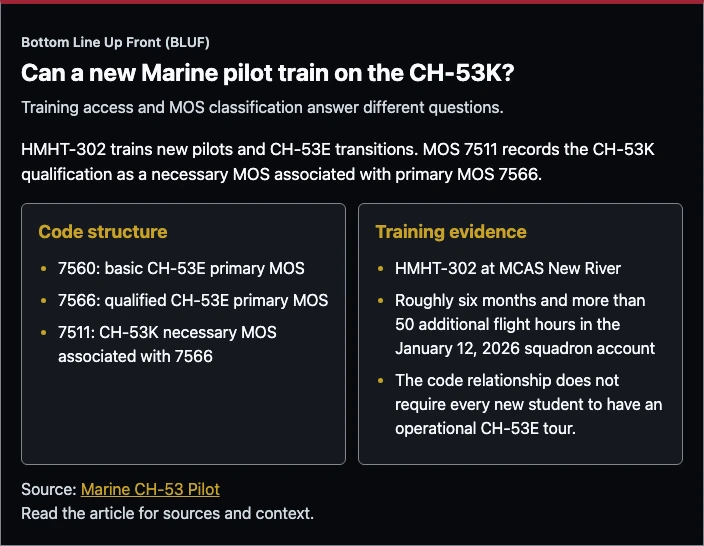
HMHT-302 trains new pilots and CH-53E transitions. MOS 7511 records the CH-53K qualification as a necessary MOS associated with primary MOS 7566.
Code structure
- 7560: basic CH-53E primary MOS
- 7566: qualified CH-53E primary MOS
- 7511: CH-53K necessary MOS associated with 7566
Training evidence
- HMHT-302 at MCAS New River
- Roughly six months and more than 50 additional flight hours in the January 12, 2026 squadron account
- The code relationship does not require every new student to have an operational CH-53E tour.
Source: Marine CH-53 Pilot
Read the article for sources and context.
On this page
Job Role and Responsibilities
The FY27 heavy-lift pilot entries distinguish primary specialties from an added aircraft qualification. A primary MOS identifies the officer’s main specialty; a necessary MOS records a qualification associated with a primary specialty. The CH-53K entry uses the second arrangement.
| Code | Title in the manual | Type | Grade band |
|---|---|---|---|
| 7597 | Basic Rotary Wing Pilot | PMOS | Second lieutenant through lieutenant colonel |
| 7560 | Pilot HMH FRS Basic/CH-53E Pilot | PMOS | Second lieutenant through lieutenant colonel |
| 7566 | Pilot HMH CH-53E Qualified | PMOS | Second lieutenant through lieutenant colonel |
| 7511 | Pilot Helicopter CH-53K | NMOS associated with 7566 | Second lieutenant through lieutenant colonel |
The CH-53E basic and qualified entries carry the same four duties. They cover commanding or assisting in command of an aviation unit, operating from land or sea with helicopter facilities, operating from small fields near ground troops, and conducting assault support missions. Those missions include troop and equipment transport, air delivery, air evacuation, and tactical recovery of aircraft and personnel.
The CH-53K entry states the mission more compactly: assault support transport of equipment, combat troops, and supplies, day or night and in all weather, during expeditionary, joint, or combined operations. Its focus is the ground force’s movement and supply requirement. Aircraft handling is part of that responsibility, alongside the officer’s duty to lead within an aviation unit.
The grade band describes the grades authorized for each code. It does not predict when an officer will promote or which billet an officer will receive. Likewise, the same duty wording in two entries does not mean a basic and a qualified pilot have identical authority aboard an aircraft.
Qualifications and Eligibility
The heavy-lift entries require Secret security clearance eligibility. That is a personnel-security prerequisite, separate from medical qualification. The basic rotary-wing entry also points to the applicable medical references, including the USN Manual of the Medical Department.
The model-specific requirements are:
- 7560: Qualification as a fleet replacement squadron basic CH-53E pilot.
- 7566: Completion of the Pilot CH-53E Qualified Course, M05P3Y4.
- 7511: Qualification as a fleet replacement squadron basic CH-53K pilot.
Fleet replacement squadron is commonly shortened to FRS. This training connects the general flying foundation an aviator has already earned to a particular aircraft and its missions. A code’s prerequisite is an award condition, not a recruiting contract or a complete description of the training syllabus.
For an applicant, the first decision remains whether to pursue Marine officer aviation. The heavy-lift codes apply later, after the officer has entered the aviation training system. The ASTB-E preparation guide explains the aviation selection test; an Officer Selection Officer can identify the requirements that apply to a particular commissioning program.
Training and Skill Development
The administrative relationship among the codes is easiest to follow as a sequence:
- Basic rotary-wing designation, 7597: A newly designated naval aviator has not yet become combat capable in a specific fleet model.
- Basic CH-53E specialty, 7560: The manual identifies the FRS basic stage for the CH-53E.
- Qualified CH-53E specialty, 7566: The officer meets the qualified-course requirement.
- Associated CH-53K qualification, 7511: The necessary MOS is recorded with 7566 rather than replacing it with a separate CH-53K primary MOS.
This sequence describes the code relationship. It should not be read as a requirement that every new CH-53K student first complete an operational CH-53E tour. The training squadron explicitly describes accepting new pilots as well as officers transitioning from the CH-53E.
In its January 12, 2026 account of HMHT-302 training, 2nd Marine Aircraft Wing describes a roughly six-month curriculum with more than 50 additional flight hours. The syllabus serves both as an introduction for new pilots and as refresher training for CH-53E transitions. Those figures describe the squadron’s curriculum at that date, rather than a duration printed in the 7511 MOS requirement.
The same account places HMHT-302 at Marine Corps Air Station New River, North Carolina, under Marine Aircraft Group 29. It identifies the squadron as the Corps’ sole fleet replacement squadron for the CH-53 platform. New-student training and transition training therefore belong in the same discussion, even though the students arrive with different experience.
Training covers aircraft systems and basic maneuvers, with attention to standardized operating procedures and crew resource management. The article describes deliberate planning and evaluation before and during flights. Completing the school prepares a pilot to continue learning in a fleet unit; it does not mean every operational qualification has already been earned.
What the Squadron Emphasizes
The January 2026 training account describes instruction in the CH-53K’s fly-by-wire systems and basic flight maneuvers. It explains that the systems help stabilize the aircraft during flight and hovering. Students still have to learn the aircraft’s systems and operating procedures; the presence of modern controls does not replace that foundation.
The account also emphasizes crew resource management, connecting the pilot’s training with the crew chiefs’ preparation. That is useful context for someone comparing a heavy-lift aircraft with a single-seat aircraft. The mission depends on a crew learning to work within common procedures, not only on an individual completing a handling exercise.
Instructors describe planning, execution, and evaluation as parts of managing risk before and during a flight. A student should therefore distinguish passing a course event from being ready for every fleet task. The squadron’s stated purpose is to build the foundation for continued development in an operational unit, with further learning after school.
Work Environment
Heavy-lift work spans three settings named in the duties:
- Land bases with helicopter facilities.
- Ships equipped for helicopter operations.
- Small fields used in close coordination with ground troops.
These are operating locations, not a fixed rotation. A mission involving equipment transport has different planning needs from an evacuation or recovery mission, even when the same aircraft supports both. The duty list establishes that range of work without supplying a daily flying schedule.
The officer’s responsibilities also extend beyond the cockpit. The manual includes command or assistance in command of an aviation unit. For a reader comparing aviation specialties, that is a reason to consider the leadership work as well as the aircraft itself.
The CH-53K Platform
NAVAIR’s CH-53K description identifies the King Stallion as the heavy-lift replacement for the CH-53E. Its stated mission is moving Marines, heavy equipment, and supplies from ship to shore during amphibious assault and subsequent operations ashore. The crew includes two pilots and one to three aircrew members, depending on the mission.
NAVAIR lists two different lift measures:
- Design lift: 27,000 pounds at a 110-nautical-mile mission radius in Navy high-and-hot conditions.
- Maximum external lift: 36,000 pounds.
These are different measures, so the maximum external load should not be paired with the stated mission radius as though they describe one performance condition.
The program page records initial operational capability in April 2022. Its older delivered-aircraft counts and FY2025 deployment projection do not establish the current fleet inventory or deployment status. Aircraft specifications help explain the heavy-lift mission; an applicant’s assignment prospects require current personnel and training information.
Salary and Benefits
A CH-53 pilot’s basic pay depends on grade and creditable service. Holding the 7511 qualification does not create a separate basic-pay table. These are 2026 monthly basic-pay examples for junior officer grades:
| Rank | Pay Grade | YOS <2 | YOS 2 | YOS 4 | YOS 6 |
|---|---|---|---|---|---|
| Second Lieutenant (2ndLt) | O-1 | $4,150 | $4,320 | $5,222 | $5,222 |
| First Lieutenant (1stLt) | O-2 | $4,782 | $5,446 | $6,484 | $6,618 |
| Captain (Capt) | O-3 | $5,534 | $6,274 | $7,383 | $7,737 |
| Major (Maj) | O-4 | $6,295 | $7,286 | $7,881 | $8,332 |
Source: DFAS 2026 pay tables. Figures reflect the 2026 pay raise.
Read the grade and years-of-service column together. The table shows basic pay only, before taxes and deductions; it is not take-home pay or a statement of the total compensation available to an aviator. Housing, subsistence, aviation incentive pay, and any bonus have their own eligibility rules.
The parent aviation profile explains the shared benefits. For a personal estimate, separate three questions: the basic-pay rate, the allowances attached to the officer’s circumstances, and any aviation program for which the officer qualifies. A specialty title alone does not answer all three.
Marine Corps Reserve
The FY27 manual applies to the Total Force, and the heavy-lift entries give the same code requirements and grade bands without a separate Reserve version. That establishes the qualification structure across components. It does not establish that a Reserve heavy-lift billet is currently open.
| Question | What the published entries establish |
|---|---|
| Does the CH-53K use a separate primary code? | No; 7511 is associated with primary code 7566. |
| Does the manual set a different Reserve clearance requirement? | No separate component requirement appears in these entries. |
| Is a specific Reserve seat available? | The entries do not provide a vacancy list. |
| Is training guaranteed to fit a civilian work schedule? | The entries do not make that commitment. |
A Reserve unit contact should confirm the actual billet, required qualifications, and available training before an officer plans a component move. Applicants should also distinguish the normal drill pattern from the full-time training and mobilization that may accompany service. General Reserve terms belong with the broader officer aviation path, not with a promise inferred from a MOS listing.
Post-Service Opportunities
The manual’s civilian occupational mappings vary by code. The basic CH-53E entry lists commercial pilots and airline pilots, copilots, and flight engineers; the qualified CH-53E entry lists commercial pilots. The CH-53K entry lists air crew officers and airline pilots, copilots, and flight engineers.
These are classifications of related work. They do not award a civilian certificate, establish that a former pilot meets an employer’s minimums, or predict a starting salary. A reader considering a civilian flying career should separate the value of military experience from the credential required for the intended aircraft and job.
The Department of Transportation describes civilian pilot certification based on military qualifications. The route requires the applicable tests and documentation, rather than an automatic conversion based solely on the MOS number. Keep training and qualification records available when preparing for that process.
For further education, the Post-9/11 GI Bill’s 2026-2027 rates include up to $30,908.34 in net tuition and mandatory fees at a private institution at the 100% benefit tier. The period runs from August 1, 2026, through July 31, 2027. Lower benefit tiers receive a percentage of the full rate, and Yellow Ribbon support depends on eligibility and school participation.
Is This a Good Job for You?
Heavy lift is a useful specialty to compare if the work that interests you is moving a ground force and its equipment. The duty list includes transport, evacuation, delivery, and recovery, with operations from ships and small fields as well as established bases. That mission gives the aircraft a different purpose from a fighter or an aerial refueler.
Consider whether that purpose appeals to you before comparing aircraft specifications. An interest in the King Stallion’s capability is reasonable, but the officer role also includes leading within an aviation unit and meeting the qualification requirements. A preferred aircraft is not a substitute for interest in the work it exists to perform.
The training evidence is particularly relevant if you are comparing a new-aviator path with a later transition. HMHT-302 describes both types of student, while the manual uses a primary-code relationship with an added CH-53K qualification. Keeping those two facts separate prevents the mistaken conclusion that the code title alone describes every student’s flying history.
More Information
Ask an Officer Selection Officer about the aviation route that applies to your background. Ask a serving heavy-lift training or assignment contact about current student placement and model qualification. Bring questions about timing, training seats, and component availability rather than assuming the MOS manual is a vacancy announcement.
Explore the Marine pilot and naval flight officer profile and compare the MV-22B Osprey and KC-130J specialties. The F-35 pilot specialty covers the fighter alternative within the same aviation field.