Marine F-35 Pilot
The Marine Corps’ FY27 MOS manual lists two F-35 pilot codes: 7516 for the basic stage and 7518 for the qualified stage. Both official titles name the F-35B, and the manual does not list a separate F-35C pilot MOS. Those titles describe the personnel-code structure; they do not mean the Marine Corps flies only one F-35 variant.
For an applicant comparing fighters with other aircraft, the first distinction is between an aviation career, a platform assignment, and a qualification recorded in an officer’s record. The Marine pilot and naval flight officer profile explains the broader aviation path. The F-35 specialty adds fighter-attack work and the training requirements below.
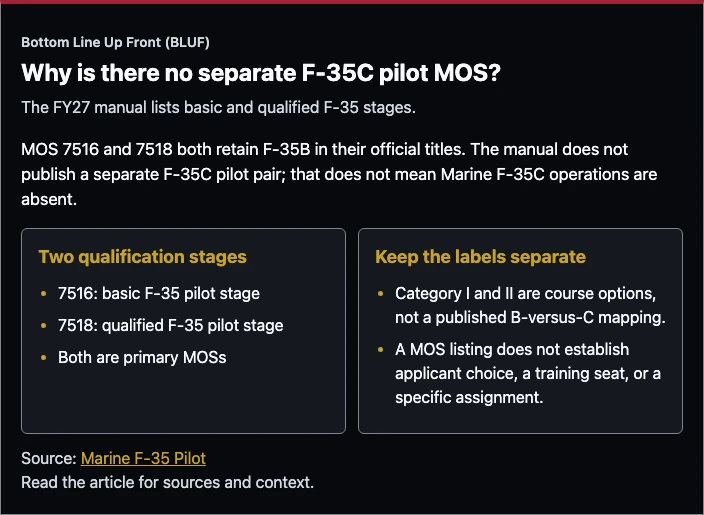
MOS 7516 and 7518 both retain F-35B in their official titles. The manual does not publish a separate F-35C pilot pair; that does not mean Marine F-35C operations are absent.
Two qualification stages
- 7516: basic F-35 pilot stage
- 7518: qualified F-35 pilot stage
- Both are primary MOSs
Keep the labels separate
- Category I and II are course options, not a published B-versus-C mapping.
- A MOS listing does not establish applicant choice, a training seat, or a specific assignment.
Source: Marine F-35 Pilot
Read the article for sources and context.
On this page
Job Role and Responsibilities
The FY27 F-35 pilot entries describe pilots operating network-enabled fighter-attack aircraft to support combat operations. The two codes share that mission and the same four published duties. They differ in training stage and award requirements.
| Code | Official title | Type | Grade band |
|---|---|---|---|
| 7516 | Pilot VMFA FRS Basic F-35B Pilot | Primary MOS | Second lieutenant through lieutenant colonel |
| 7518 | Pilot VMFA FRS F-35B Qualified | Primary MOS | Second lieutenant through lieutenant colonel |
VMFA identifies the fighter-attack community, and FRS refers to fleet replacement squadron training. Basic and qualified identify stages within the specialty. They are not names for the B and C variants.
Both entries list these responsibilities:
- Commanding or assisting in command of an aviation unit.
- Operating from naval shipping, expeditionary fields, or land bases.
- Supporting five functions of Marine aviation in all weather, day and night: offensive air support, anti-air warfare, electronic warfare, assault support, and reconnaissance.
- Providing air defense through coordination with airborne or ground-control intercept units against attacking aircraft and missiles.
These duties place the flying inside a larger command and mission. The officer must work with other aviation and control elements as well as operate the aircraft. The command wording does not mean every newly trained pilot is already a squadron commanding officer.
The grade band is also a classification, rather than a promotion schedule. A qualified pilot code does not automatically confer a particular billet or level of command. Grade, aircraft qualification, and assigned responsibility remain separate facts when evaluating an officer’s job.
Why the Manual Does Not List a Separate F-35C Pilot MOS
The published entries use a basic/qualified pair, with F-35B retained in both titles. The index contains no parallel F-35C pilot pair. For a reader trying to find a separate F-35C officer code, that is the answer the current listing supplies.
It does not follow that the F-35C is absent from Marine aviation. A July 31, 2024 wing release about VMFA-311 describes Marine F-35C operations and the squadron’s initial operational capability. The aircraft exists in the operational record even though the personnel titles retain F-35B wording.
The release describes the C variant’s heavier landing gear and enlarged, foldable wings for carrier operations. It names VMFA-311 and VMFA-314 at Marine Corps Air Station Miramar as of that release. Those are dated examples, not a complete 2026 squadron inventory or an assignment guarantee.
Do not use the course categories below as a shortcut for identifying variants. The MOS entry offers Category I and Category II courses at several locations without mapping one category to the B and the other to the C. A course category, a location, and an aircraft variant are not interchangeable labels.
An applicant should therefore ask about aviation selection and platform assignment directly. The presence of a MOS title does not establish that an applicant can select or contract for that aircraft. A serving aviator’s training placement likewise requires the current assignment and training instructions, not an inference from the title alone.
Qualifications and Eligibility
Both F-35 entries require Top Secret security clearance eligibility. The medical and training prerequisites should be read separately from that personnel-security condition. A clearance requirement is not a flight physical.
For the basic code, 7516, the manual lists the centrifuge-based flight environment trainer course, with identifiers A17KZA1 or M17P2E3. It also states that OPNAV-directed training-seat allocations and funding are coordinated between TECOM and/or MATSG-21. In other words, having the published prerequisites does not by itself establish that a training seat is available.
The qualified code, 7518, adds these conditions:
- Completion of the centrifuge-based flight environment trainer course, A17KZA1.
- The medical requirements identified by reference (ah) and the USN Manual of the Medical Department.
- Completion of an accepted Aircrew Refresher NASTP Training Class 3 Aircraft Course.
- Completion of an applicable F-35 Category I or Category II course, or the stated Air Force equivalent.
The accepted aircrew refresher identifiers are M04P2E7, M17P2E3, N02P2E4, N04P2E5, N06P2E3, N23P2E4, N26P2E3, and N37P2E1. These identify accepted courses; they are not eight courses every officer must complete. The training authority determines the appropriate placement within the published requirement.
Training and Skill Development
The F-35-specific progression is from the basic stage to the qualified stage. Before it, an officer completes the aviation preparation and flight training relevant to the assigned path. An applicant still preparing for selection can use the ASTB-E guide for test background without confusing the exam with an F-35 course requirement.
The qualified-code entry lists the following course options:
| Category | Location or equivalent | Identifier |
|---|---|---|
| I | MCAS Beaufort, South Carolina | M16F3F1 |
| I | MCAS Miramar, California | M17F3FC |
| I | NAS Lemoore, California | N04F3M6 |
| I | Air Force equivalent for Category I students | USAF Category I equivalent |
| II | MCAS Beaufort, South Carolina | M16F351 |
| II | MCAS Miramar, California | M17F35C |
| II | NAS Lemoore, California | N04F3N6, Category II-A |
| II | NAS Lemoore, California | N04F3P6, Category II-B |
| II | NAS Lemoore, California | N04F3Q6, Category II-C |
| II | Air Force equivalent for Category II students | USAF Category II equivalent |
Read this as a set of accepted routes to the qualified-code requirement, rather than a menu an applicant chooses from. The table does not establish current course dates, seat availability, duration, or the appropriate category for a particular officer. Those questions belong with the training command.
A useful training conversation separates what an officer has already completed from what remains. The basic-code prerequisites, the qualified-code prerequisites, and the F-35 course requirement answer different parts of that question. Keeping the documentation for each makes it easier to identify an actual gap without mistaking a missing course identifier for a different aircraft specialty.
Work Environment and Duty Stations
The duty statements span ships, expeditionary fields, and established land bases. They also describe all-weather and night operations. Those conditions explain the range of employment without establishing how often any particular pilot works from each location.
The officer’s work includes supporting a unit’s mission alongside the flying qualification. Air defense requires coordination with other airborne or ground-control elements, while the broader mission list reaches beyond interception alone. A reader comparing platforms should compare those duties rather than assuming all fighter work is the same.
The 2024 Miramar example is useful evidence of F-35C unit basing at a stated date. It does not establish where an individual officer will serve, which unit has vacancies, or how the current deployment calendar is arranged. Current orders and unit information determine those matters.
Career Progression and Advancement
Earning 7518 records the qualified stage, rather than a promotion in military grade. The manual also lists 7518 among the acceptable primary codes for several later necessary MOSs. These qualifications add training or instructor responsibilities while the officer retains the underlying aviation specialty.
| Added qualification | Code | Relationship to 7518 |
|---|---|---|
| Marine Division Tactics Instructor | 7537 | 7518 is one of the accepted prerequisite codes. |
| Strike Fighter Tactics Instructor | 7542 | 7518 is one of the accepted prerequisite codes. |
| Forward Air Controller (Airborne) Instructor qualification | 7544 | 7518 is one of the accepted prerequisite codes. |
Each has additional requirements. The strike fighter instructor entry includes the TOPGUN Strike Fighter Tactics Instructor Course, N39KYB1; the other two refer to the aircraft-specific MAWTS-1 course catalog. Being in an accepted primary MOS is therefore the beginning of an eligibility check, not an automatic follow-on award.
These qualifications should also be distinguished from selection for command or promotion. A course can establish a required skill without promising the next assignment. Officers considering an instructor path should discuss their existing qualifications and the current requirement with their training and assignment contacts.
For example, an officer holding the qualified F-35 primary MOS still has to meet the separate instructor qualification’s conditions. The primary-code prerequisite establishes an accepted background, while a named instructor course or referenced catalog establishes further requirements. Listing the two together is not evidence that an officer has already completed both, or that an instructor billet is available.
Salary and Benefits
F-35 pilots use the same basic-pay system as other commissioned officers. Grade and creditable service determine the rate; the aircraft variant does not create a different basic-pay table. The following table shows 2026 monthly examples for O-1 through O-4, not the full grade range of the specialty.
| Rank | Pay Grade | YOS <2 | YOS 2 | YOS 4 | YOS 6 |
|---|---|---|---|---|---|
| Second Lieutenant (2ndLt) | O-1 | $4,150 | $4,320 | $5,222 | $5,222 |
| First Lieutenant (1stLt) | O-2 | $4,782 | $5,446 | $6,484 | $6,618 |
| Captain (Capt) | O-3 | $5,534 | $6,274 | $7,383 | $7,737 |
| Major (Maj) | O-4 | $6,295 | $7,286 | $7,881 | $8,332 |
Source: DFAS 2026 pay tables. Figures reflect the 2026 pay raise.
Basic pay is only one component of compensation. Housing and subsistence allowances, aviation incentive pay, and any bonus require their own eligibility checks. Compare those components separately rather than treating the officer’s aircraft code as a statement of total pay.
The parent aviation profile covers shared benefits and the officer career path. For personal planning, establish the applicable grade and service bracket first, then confirm the allowances and aviation programs attached to the actual assignment. A comparison based only on the aircraft name misses those conditions.
Marine Corps Reserve and Family Planning
The MOS manual applies to the Total Force and does not publish a separate Reserve F-35 code pair. That fact does not establish current Reserve F-35 vacancies. Qualification applicability and billet availability are different questions.
An officer considering Reserve service should confirm the actual unit, billet, aircraft qualification, and training requirement before planning around a civilian job. The existence of a code is not evidence that a course can be scheduled part time. A component contact must establish the available route and its obligations.
For a household, the published mission establishes the possibility of shipboard, expeditionary, and land-base operations. It does not supply a deployment length, move cycle, or predictable flying schedule. Use current unit information to discuss likely absences, notice, and support rather than converting an occupational description into a family calendar.
Post-Service Opportunities
The manual gives the basic entry a civilian mapping to airline pilots, copilots, and flight engineers, SOC 53-2011. The qualified entry’s related SOC field is None. That difference in the classification fields does not mean qualification removes an officer’s flying experience or determines civilian employability.
Civilian flying depends on the certificates, ratings, and experience required for the intended job. The Department of Transportation explains how military pilots can pursue civilian credentials, including the applicable testing and documentation. A military MOS is evidence of service qualification, not a civilian license in itself.
An officer planning further education can also review current Post-9/11 GI Bill rates. The private-school cap is $30,908.34 for August 1, 2026, through July 31, 2027, at the 100% benefit tier. Lower eligibility tiers receive a percentage of the full rate, and school participation and eligibility govern additional Yellow Ribbon support.
Is This a Good Job for You?
The fit question starts with fighter-attack work and Marine officership. The mission includes air defense, support to other aviation functions, and operating in several settings. An interest in one variant is useful motivation, but it does not answer whether the broader role appeals to you.
Compare the work with the MV-22B Osprey specialty and KC-130J specialty. They emphasize transport and assault support or refueling rather than the fighter-attack mission. The comparison is about the job each aircraft supports, not a prediction of selection chances or serving pilots’ satisfaction.
More Information
Ask an Officer Selection Officer about the aviation path and the selection conditions that apply to your background. Serving officers should use current training and assignment guidance for category placement, platform transitions, and follow-on qualifications. Keep the code question separate from those decisions: the FY27 listing identifies the basic and qualified F-35 stages, while an actual aircraft assignment requires additional information.
Explore the Marine pilot and naval flight officer profile alongside the MV-22B and KC-130J specialties for the shared aviation route and the other platform missions.