Marine KC-130J Pilot
A Marine KC-130J pilot flies a transport and aerial refueling aircraft in support of the Marine Air-Ground Task Force (MAGTF). The specialty has two primary codes: 7556 for co-pilots and 7557 for aircraft commanders. The codes identify different qualification stages even though the MOS manual gives them the same published duty list.
That distinction matters when comparing a tanker career with fighter or tiltrotor flying. KC-130 work combines crew supervision, load planning, transport, and refueling. The Marine pilot and naval flight officer profile covers commissioning and the aviation pipeline before platform-specific qualification.
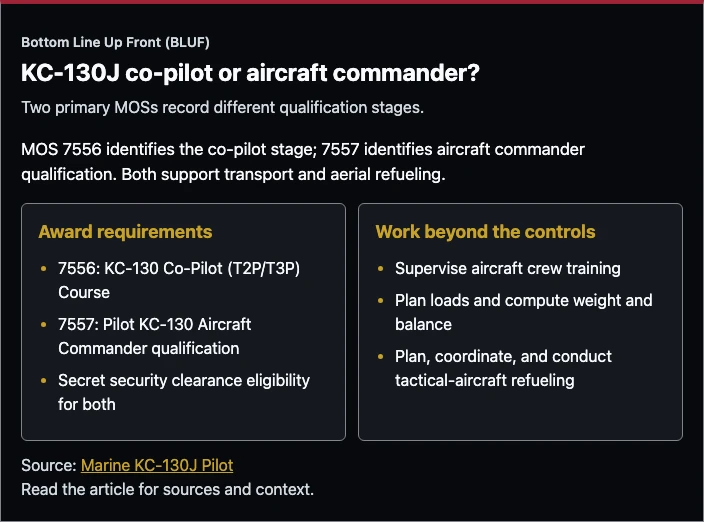
MOS 7556 identifies the co-pilot stage; 7557 identifies aircraft commander qualification. Both support transport and aerial refueling.
Award requirements
- 7556: KC-130 Co-Pilot (T2P/T3P) Course
- 7557: Pilot KC-130 Aircraft Commander qualification
- Secret security clearance eligibility for both
Work beyond the controls
- Supervise aircraft crew training
- Plan loads and compute weight and balance
- Plan, coordinate, and conduct tactical-aircraft refueling
Source: Marine KC-130J Pilot
Read the article for sources and context.
On this page
Job Role and Responsibilities
The FY27 KC-130 pilot entries place both codes in the Marine aviation field. They describe transport and turboprop aerial refueler operations, with the co-pilot and aircraft commander distinguished by the qualification required. Both codes span second lieutenant through lieutenant colonel.
| Code | Title | Requirement in the entry |
|---|---|---|
| 7556 | Pilot VMGR KC-130 Co-Pilot (T2P/T3P) | KC-130 Co-Pilot (T2P/T3P) Course, M04P3D2 or M17P3D5 |
| 7557 | Pilot VMGR KC-130 Aircraft Commander | Qualification as a Pilot KC-130 Aircraft Commander |
Both entries identify four areas of work:
- Supervising aircraft crew training in flight duties.
- Commanding or assisting in command of an aviation unit.
- Supervising loading, computing weight and balance, and planning, coordinating, and conducting aerial refueling.
- Operating in airlift, air supply, evacuation, refueling, and long-range navigation escort missions, as appropriate.
The loading and weight-and-balance duty distinguishes this job from a description centered only on aircraft handling. The officer helps make the aircraft usable for the load or support mission it has been assigned. Crew training and coordination are part of that responsibility.
The two duty lists do not establish that a co-pilot and an aircraft commander have identical cockpit authority. They describe the occupation at a broad level. The code titles and their award requirements still distinguish the officer’s qualification.
Mission and Aircraft
The NAVAIR KC-130J fact sheet, dated 2018, describes assault support to the MAGTF commander. Its mission list includes:
- Air-to-air refueling and aviation-delivered ground refueling.
- Assault air transport and tactical aerial delivery.
- Battlefield illumination and airborne radio relay.
- Tactical aeromedical evacuation, close air support, and multisensor imagery reconnaissance.
Those descriptions establish the aircraft’s range of missions at the date of the fact sheet. They do not mean that every aircraft configuration or every crew performs every listed mission on a particular deployment. Mission assignment and qualification need to be checked against the actual unit.
The fact sheet lists a pilot, co-pilot, and crewmaster as crew roles. That is useful background for understanding the collective work: the mission depends on more than one pilot and includes responsibilities for the aircraft’s load. Its historical inventory counts are not a current fleet total.
For an applicant, the central comparison is whether transport and support flying appeals more than a different aviation mission. Refueling sustains other aircraft; transport moves the people and material the force needs. Both require the officer to understand the supported mission as well as the flight itself.
Qualifications and Eligibility
Both MOS entries require Secret security clearance eligibility. The requirement is the same for the co-pilot and aircraft commander codes. It is a security condition, separate from the medical qualification required to fly.
The co-pilot entry names the KC-130 Co-Pilot course and its accepted course identifiers. The aircraft commander entry states the aircraft commander qualification without supplying a separate course identifier. Neither entry provides a minimum flight-hour total or a fixed number of years between the two stages.
An officer should therefore distinguish an award requirement from a complete qualification syllabus. A short MOS entry identifies what must be held for the code; current training instructions establish the detailed events, evaluations, and standards. The code alone is not enough to plan an upgrade date.
Applicants first need the commissioning and aviation-selection route relevant to their background. The ASTB-E guide explains the aviation selection exam. It should not be read as a KC-130 course requirement or a promise of assignment to this aircraft.
For medical screening and flight school, use the parent aviation profile and the current instructions supplied through the selection process. The absence of medical detail in the KC-130 MOS entries does not exempt a pilot from aviation medical standards. A personnel code and medical qualification answer different questions.
Training and Skill Development
The qualification path has two distinct milestones:
- Co-pilot qualification: Complete the KC-130 Co-Pilot (T2P/T3P) Course associated with 7556.
- Aircraft commander qualification: Meet the aircraft commander requirement associated with 7557.
The identifiers M04P3D2 and M17P3D5 identify the published co-pilot course options. T2P/T3P is part of the official title. It should not be turned into an invented course duration or an applicant eligibility rule.
The broad duty list explains why training reaches beyond flying the aircraft. It includes the load, weight and balance, crew training, and planning for refueling tactical aircraft. A pilot’s development must support the assigned mission as well as the handling qualification.
There is no published upgrade timeline in these two MOS entries. That is a reason to obtain the actual qualification plan from the training authority, rather than to estimate a promotion or hours threshold from the difference between the titles. A change in aircraft qualification is also different from a promotion in officer grade.
Work Environment
KC-130J work connects ground preparation with airborne support. The manual explicitly places loading, weight and balance, and refueling coordination within the officer’s responsibilities. These duties provide a more useful picture of the work than describing it simply as flying a large aircraft.
The mission list includes transport, evacuation, refueling, and navigation escort. The common element is supporting a force or another aircraft, with the required load or support task shaping the flight. The published entries do not prescribe a single daily schedule for those missions.
The officer also supervises crew training and commands or assists in command of an aviation unit. That adds a leadership role to the flying work. An applicant who is interested only in aircraft controls should consider whether the crew and unit responsibilities are equally appealing.
Career Progression and Advancement
The most important progression specific to this specialty is the move from co-pilot to aircraft commander qualification. The two MOSs record those stages while retaining the same basic mission. The qualification change should not be described as merely a new title, nor should it be confused with promotion from one officer grade to another.
The manual lists both codes for second lieutenant through lieutenant colonel. It does not assign a required grade to each cockpit position within that band. A table of typical officer promotion years would therefore answer a different question from the specialty’s qualification requirements.
Serving officers can make a more useful career plan by separating three records: military grade, aircraft qualification, and the assigned billet. Each can change at a different time. The parent aviation profile provides the wider officer-career context, while current unit and assignment guidance establishes the actual opportunities.
Physical Demands and Medical Evaluations
The MOS entries identify a security prerequisite but do not reproduce the flight physical standards. Those standards apply through the aviation medical system. A prospective pilot should complete the required medical process rather than interpreting the short entry as a complete medical checklist.
The same distinction applies to physical fitness. Marine officer fitness requirements and aircraft medical qualification are separate obligations; neither replaces the other. The parent aviation profile explains the general PFT, CFT, and flight-physical context.
Deployment and Duty Stations
The KC-130 duty entries describe missions rather than naming a guaranteed station. Airlift, evacuation, aerial refueling, and long-range navigation escort identify what the aircraft supports. They do not establish which installation an officer will receive or the frequency of deployments.
The dated NAVAIR fact sheet adds mission background, not an assignment forecast. Its old aircraft counts should not be used to calculate present-day chances of receiving a billet. An assignment contact or unit can establish the relevant aircraft, location, and qualification requirement.
For a reader comparing platforms, this means station preference should be discussed separately from mission preference. Interest in transport or refueling does not by itself establish an available location. Current assignments, rather than an old inventory figure, determine the practical options.
Risk, Safety, and Legal Considerations
The manual makes loading, weight and balance, and refueling coordination explicit responsibilities. These are useful subjects to ask about when learning how the crew prepares a mission and checks its work. They are part of the job, not administrative detail unrelated to flying.
Command or assistance in command adds responsibility for an aviation unit alongside aircraft duties. The published list does not specify the authority of every crew position or reproduce operating procedures. Those come from the applicable training, operating, and command instructions.
The occupational description also does not quantify mishap risk. A reader should not infer a safety ranking against fighters, helicopters, or tiltrotors from the support mission alone. The supported conclusion is that this specialty includes both flight and crew-management responsibilities.
Impact on Family and Personal Life
A household needs current unit information to plan around flying, training, and absences. The MOS entries do not provide a deployment length, move cycle, or predictable weekly schedule. The aircraft’s support role is not evidence of either a quiet schedule or a particular deployment tempo.
Moving from co-pilot to aircraft commander can change an officer’s responsibilities, but identical duty lists do not establish identical effects on the household. Ask about the actual upgrade training and assigned billet rather than assuming the family routine stays the same. Keep any expected course or deployment dates separate from the general career description.
The shared officer aviation profile covers family-support resources. The useful specialty questions concern the unit: where training occurs, which qualifications are required, and how upcoming operations affect attendance and availability. Those answers can change without a change to the MOS title.
Marine Corps Reserve
The manual applies to the Total Force and lists the same code requirements without a separate Reserve qualification. Applicability does not establish a vacancy. A specific Reserve KC-130J opportunity requires an actual unit and billet match.
Before planning a component move, establish the following:
- The unit’s current billet and required aircraft qualification.
- Whether the officer meets the co-pilot or aircraft commander requirement.
- The full-time training needed before filling the billet.
- The service and mobilization obligations attached to the actual arrangement.
General drill patterns are not a substitute for that information. Reserve training or active-duty orders can require more time than a routine monthly drill period. The parent profile supplies general component context; the unit and assignment authorities establish the available opening.
Post-Service Opportunities
Both code entries map the occupation to airline pilots, copilots, and flight engineers, SOC 53-2011. That relationship identifies related civilian work without awarding a certificate or guaranteeing a job. Civilian employers still assess the experience and credentials required for the position.
The Department of Transportation explains civilian certification routes for military pilots. Testing and documentation remain part of the process. Keep records of training, flight experience, and qualification available rather than relying on the MOS number alone to describe the background.
For education, the 2026-2027 Post-9/11 GI Bill rates provide a private-school tuition and mandatory-fee cap of $30,908.34 at the 100% tier. This period runs from August 1, 2026, through July 31, 2027. Lower tiers receive a percentage of the full benefit.
Is This a Good Job for You?
Consider the KC-130J if transport, refueling, and working within an aircraft crew appeal to you. The published responsibilities include planning and coordinating support, supervising crew training, and accounting for the aircraft’s load. Those tasks are a better fit test than comparing size or speed alone.
Compare the MV-22B Osprey specialty if your interest is tiltrotor assault support. The F-35 specialty addresses fighter-attack work. Different missions create different qualification demands, without the comparison promising which platform an applicant will receive.
More Information
Ask an Officer Selection Officer about the aviation route relevant to your background. Serving aviators should bring qualification and assignment questions to their training and personnel contacts. Identify whether the question concerns entering aviation, qualifying as a co-pilot, upgrading to aircraft commander, or finding a particular billet; each requires different information.
Explore the Marine pilot and naval flight officer profile with the MV-22B Osprey and F-35 specialties to compare the shared aviation route and the platform missions.