Marine MV-22B Osprey Pilot
A Marine MV-22B Osprey pilot flies a tiltrotor that can operate as a helicopter or a turboprop aircraft. The specialty uses two primary MOSs: 7531 for the basic stage and 7532 for the qualified stage. Both belong to the same V-22 community, with the qualified code requiring completion of the V-22 Qualified Course.
Tiltrotor capability supports a specific purpose: moving troops, equipment, and supplies from ships and land bases for combat assault and assault support. The Marine pilot and naval flight officer profile explains the aviation path before platform qualification. The Osprey specialty adds the aircraft and mission requirements below.
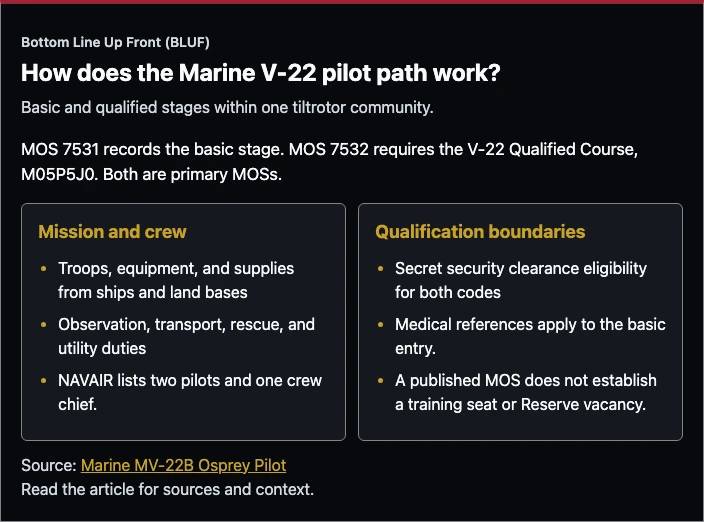
MOS 7531 records the basic stage. MOS 7532 requires the V-22 Qualified Course, M05P5J0. Both are primary MOSs.
Mission and crew
- Troops, equipment, and supplies from ships and land bases
- Observation, transport, rescue, and utility duties
- NAVAIR lists two pilots and one crew chief.
Qualification boundaries
- Secret security clearance eligibility for both codes
- Medical references apply to the basic entry.
- A published MOS does not establish a training seat or Reserve vacancy.
Source: Marine MV-22B Osprey Pilot
Read the article for sources and context.
On this page
Job Role and Responsibilities
The FY27 V-22 pilot entries describe observation, transport, rescue, and utility missions. They list both codes as primary MOSs, rather than as added necessary qualifications on a different primary specialty. Both span second lieutenant through lieutenant colonel.
| Code | Official title | Qualification stage |
|---|---|---|
| 7531 | Pilot VMM FRS Basic V-22 Pilot | Basic fleet replacement squadron stage |
| 7532 | Pilot VMM V-22 Qualified | Qualified stage |
The complete qualified entry lists four duties, matching the broad duty areas in the basic entry:
- Operating aircraft from ship or land bases.
- Commanding or assisting in command of an aviation unit.
- Operating from small fields in close coordination with ground troops.
- Conducting missions that include troop and equipment transport, evacuation, maritime special operations, mobile forward area refueling, and tactical recovery of aircraft and personnel.
These duties describe assault support closely tied to the force on the ground. The aircraft can carry people or equipment, support an evacuation, or contribute to recovery and other support tasks. The mission and the operating location should be considered together when comparing the specialty with another aviation path.
The identical broad duty areas do not erase the distinction between basic and qualified pilots. The code records a training stage, while the officer’s actual responsibilities depend on qualification and assignment. The published grade range also does not promise a particular cockpit position at a particular rank.
What Makes the Osprey Different
NAVAIR describes the MV-22B as a tiltrotor vertical/short takeoff and landing aircraft. It can operate in helicopter and turboprop modes. That capability is more precise than describing it as a faster helicopter, because both modes are part of the aircraft’s design.
The same product description gives the mission as transport from ships and land bases for combat assault and assault support. It lists a crew of two pilots and one crew chief. Those roles help explain why the specialty involves a crew and coordination with the supported force, rather than only an individual pilot’s handling skill.
NAVAIR records initial operational capability for the MV-22B in June 2007. That is a historical milestone, not a measure of present readiness. Its product page carries older program information, so the aircraft description should not be used to infer current deployment or maintenance status.
For an applicant, the useful comparison is the work the aircraft supports. A fighter-attack pilot and a tiltrotor assault-support pilot both serve in aviation but support different missions. Interest in conversion between flight modes is relevant, alongside interest in moving and supporting ground forces.
Qualifications and Eligibility
Both V-22 entries require Secret security clearance eligibility. Security screening is separate from the flight physical and other medical conditions that govern naval aviation. Meeting one requirement does not establish that the others have been met.
The basic entry points to the applicable medical references, including the USN Manual of the Medical Department. The qualified entry requires completion of the V-22 Qualified Course, M05P5J0. These are published MOS award conditions, rather than a complete account of aviation accession.
Applicants still need the officer and aviation route that applies to their background. The ASTB-E guide explains the aviation selection test and its preparation context. It does not replace program-specific guidance from an Officer Selection Officer.
It is useful to keep three questions separate when preparing a package:
- Does the applicant meet the requirements for the selected commissioning program?
- Does the applicant meet the aviation testing and medical requirements?
- What training and qualification will apply after a platform assignment?
The MOS entries mainly answer the third question. They do not establish that a particular aircraft is available to an applicant. Platform interest can guide questions and preparation without becoming an assumed assignment.
Training and Skill Development
The specialty’s published progression runs from the basic V-22 stage to the qualified stage. Fleet replacement squadron training connects earlier flight training to the model and its missions. The two codes identify that progression rather than two unrelated jobs.
| Stage | Code | Published requirement |
|---|---|---|
| Basic | 7531 | Meet the applicable medical reference requirements. |
| Qualified | 7532 | Complete the V-22 Qualified Course, M05P5J0. |
The full MOS entries provide the duties for both stages. They do not provide a course calendar or an upgrade duration. A student or serving officer should obtain the actual schedule and qualification plan from the training authority.
Conversion between flight modes is part of the aircraft’s capability, but the capability alone is not a syllabus. The broad duty list also includes ship or land operations, small-field coordination, and several support missions. Training questions should therefore cover the required operating and mission qualifications as well as aircraft handling.
The parent aviation profile covers the flight-school path that precedes this specialty. Keeping those stages in order helps an applicant avoid planning around an advanced aircraft course before the earlier selection and medical requirements are settled. Serving officers entering a different training route should follow the instructions for that route rather than assume the new-student sequence applies unchanged.
Work Environment
V-22 pilots operate from ships, land bases, and small fields in coordination with ground troops. These settings describe the range of employment. They do not establish how an individual unit divides its time among them.
The missions connect the aircraft to a supported force. Troop transport, evacuation, and tactical recovery each put the flight in a wider operation with its own requirements. An officer comparing specialties should consider that support relationship, not just the aircraft’s flight modes.
The unit leadership duty also remains part of the job. Commanding or assisting in command of an aviation unit is different from qualifying on the aircraft, even though both belong to the officer’s career. The manual does not imply that a newly trained pilot immediately commands a squadron.
Career Progression and Advancement
The move from 7531 to 7532 records completion of the qualified-stage requirement. It is an aircraft qualification change, not a promotion in officer grade. Both entries cover the same authorized grade band.
Promotion, instructor qualification, flight leadership, and assigned billet should be treated as separate parts of career development. A code can identify a required qualification without establishing how quickly an officer will reach it or what assignment follows. Current training and personnel guidance supplies the actual opportunities.
A practical career discussion should start with the officer’s present qualifications and the billet’s requirements. If additional training is needed, establish which events or course satisfy the gap and when they are available. This is more useful than assuming that time spent holding the basic code automatically awards the qualified one.
Physical Demands and Medical Evaluations
The basic entry’s medical reference is an award condition, not a list of disqualifying diagnoses. Applicants need the required aviation medical evaluation to establish their own eligibility. A general comparison of aircraft types cannot answer an individual flight-physical question.
Marine fitness requirements remain separate from aviation medical qualification. The parent profile provides the PFT, CFT, and flight-physical context shared across Marine aviation. Neither the tiltrotor’s capability nor the Secret clearance prerequisite replaces those requirements.
Deployment and Duty Stations
The duty statements identify operating settings without promising a station. A shipboard mission, a land-base mission, and a small-field operation are different forms of employment that can occur within the same specialty. The MOS number does not provide an officer’s deployment calendar.
Current unit and assignment information is needed to establish the relevant station, training location, and likely absences. The historical IOC date should not be used to infer current readiness, and a general platform description is not a source for current vacancies. Ask about the actual unit rather than treating every Osprey billet as interchangeable.
Risk, Safety, and Legal Considerations
The duties combine aviation operations with close coordination around supported ground forces. The pilot must meet the applicable aircraft and mission standards while serving within the unit’s command structure. These responsibilities are part of the job even when an occupational description does not reproduce the operating procedures.
The complete MOS entry is not a substitute for aircraft operating, training, or safety instructions. It also does not quantify mishap risk or establish a safety comparison with other platforms. A reader assessing the career should use current operational and safety information for those questions.
Command or assistance in command adds unit responsibility alongside the flying role. That wording should not be read as authority to conduct any mission simply because it appears in the broad list. Actual qualifications, orders, and the applicable command authorities govern the officer’s work.
Impact on Family and Personal Life
Shipboard and expeditionary operations make possible absences relevant to household planning. The exact schedule depends on the assigned unit and its training and operations. The published duties do not establish a fixed move cycle, a deployment length, or how much notice a family will receive.
Before making a decision around a location or a civilian spouse’s job, ask which training periods and assignments are actually expected. Separate confirmed dates from planning assumptions. The same specialty can involve different circumstances as the billet and unit change.
The aircraft’s two-pilot and crew-chief complement describes the crew, not a promise about social support or family experience. Shared officer and installation resources can help with moves and absences, while the unit provides the practical information needed to plan. Personal fit should account for uncertainty without turning that uncertainty into an invented timetable.
Marine Corps Reserve
The FY27 manual applies to the Total Force and lists no separate Reserve V-22 code pair. This establishes the qualification framework across components. It does not establish that a Reserve unit has an open Osprey pilot billet.
A serving officer considering Reserve affiliation should confirm the actual unit, billet, required aircraft qualification, and available training. The normal drill pattern does not describe every training or mobilization obligation. Obtain those details before assuming the arrangement fits a civilian work schedule.
An applicant should also distinguish interest in a platform from an available commissioning and assignment route. A published MOS is not a reservation for an individual. The parent aviation profile supplies the general component context, and the appropriate personnel contact establishes the available opportunity.
Post-Service Opportunities
The V-22 entries map the occupation to airline pilots, copilots, and flight engineers, SOC 53-2011. That is a related-work classification, rather than a civilian certificate or employment promise. The aircraft category and ratings needed for a civilian position still matter.
The Department of Transportation describes civilian pilot certification based on military qualifications. Applicable tests and documentation are part of the process. Officers preparing for civilian flying should keep records of aircraft experience and qualification and identify the requirements for the intended job.
The Post-9/11 GI Bill’s 2026-2027 rates provide up to $30,908.34 in net private-school tuition and mandatory fees at the 100% benefit tier. The period runs from August 1, 2026, through July 31, 2027. Lower benefit tiers receive a percentage of that rate.
Is This a Good Job for You?
Consider whether assault support and working with ground forces appeal to you. Transport, evacuation, recovery, and other support tasks give the aircraft a purpose beyond its ability to convert between flight modes. The published duties are a useful basis for deciding whether that purpose matches your interests.
Crew work is another practical comparison. The aircraft has two pilots and a crew chief, and the duties include both aircraft operations and unit leadership. Interest in the aircraft should sit alongside willingness to train and work within that wider team.
The KC-130J specialty emphasizes transport and refueling, while the CH-53 heavy-lift specialty emphasizes moving heavy equipment and supplies. Compare the missions and qualification paths rather than treating any of the aircraft as a guaranteed selection.
More Information
Ask an Officer Selection Officer about the officer aviation path and the requirements relevant to your background. Serving officers should use their training and assignment contacts for model qualification, training seats, and component opportunities. The questions to settle are the actual route, the required qualification, and the available assignment.
Explore the Marine pilot and naval flight officer profile with the KC-130J and CH-53 specialties for the shared aviation route and the different support missions.